Boeing Plays Defense: Why the New Patriot Deal Matters for BA Stock

12 minutes for reading
Boeing signed a seven-year framework agreement with Lockheed Martin and the Pentagon to expand production of PAC-3 MSE Patriot interceptor seekers — the guidance systems that are critical for defeating ballistic and hypersonic threats. Against the backdrop of escalating tensions in the Middle East, demand for missile defense systems is growing, securing a long-term revenue stream for Boeing's defense division.
In Brief
- Rising tensions in the Middle East are driving demand for missile defense systems.
- Boeing stands to gain additional long-term revenue growth in its defense segment.
- 24 out of 29 Wall Street analysts rate BA stock as a Buy.
- Boeing shares are approaching oversold territory, signaling a likely near-term recovery.
Trade Idea Parameters
Below are the specific parameters for the Boeing trade idea. The ticker for trading via MobileTrader and MT5 on RoboForex is BA.
| Parameter | Value |
|---|---|
| Instrument | Boeing Co (NYSE: BA) |
| Ticker in MobileTrader / MT5 | BA |
| Idea Date | April 7, 2026 |
| Time Horizon | 6–12 months |
| Direction | ↑ Buy (Long) |
| Entry Level (trigger) | 210 USD |
| Take Profit | 280 USD |
| Stop Loss | 187 USD |
| Position Size | No more than 3% of account · Medium risk |
Instant Access to Global Markets with RoboForex MobileTrader
Deal Details: Pentagon Agreement
On April 1, 2026, the Pentagon announced a seven-year framework agreement with Boeing and Lockheed Martin aimed at tripling production capacity for PAC-3 MSE seekers used in the Patriot air defense system. Boeing manufactures one of the most critical components of the system — the guidance unit responsible for detecting, tracking, and engaging targets. Production growth is set to begin immediately, with both parties planning to formalize a full multi-year contract by the end of 2026.

Boeing was actually prepared for this ahead of time. The company reported investing more than 200 million USD since 2024 in expanding its Huntsville facilities, including the launch of a new production floor of approximately 3,250 m² (35,000 sq ft). The results are already visible: by the end of 2025, deliveries of guidance systems grew by more than 30%. The company was already prepared for the agreement with the Pentagon and was increasing production capacity beforehand. Thus, the new agreement solidifies Boeing's status as a strategic partner of the US Ministry of War in a critical segment of the defense industry.
What This Means for Boeing’s Revenue
The new agreement cannot yet be treated as a fixed revenue contract since the exact value of future income has not been disclosed. Nevertheless, it improves the visibility of future defense orders, allows Boeing to expand production against confirmed government demand, and increases the likelihood of additional long-term contracts.
- The agreement improves order visibility. While investors cannot yet see a precise revenue figure, the Pentagon deal confirms that demand for Boeing's defense products is recurring rather than one-off — which matters for capacity utilization planning and production scheduling.
- The defense segment is becoming increasingly important to Boeing. In 2025, revenue from the Defense, Space & Security division grew 14% to 27.23 billion USD, while the order backlog reached a record 85 billion USD — showing that the defense business is taking on an ever-greater role in the company's overall structure.
- Revenue growth has not yet translated into margin improvement. Despite higher order volumes, the defense segment's operating margin remained weak in 2025 at negative 0.5%. Boeing must not only ramp up production but also improve contract execution efficiency to convert revenue growth into sustainable profit.
- New agreements could improve segment margins. Expanding defense orders increases the likelihood of more consistent capacity utilization and creates conditions for gradual margin normalization. If Boeing can scale production efficiently, this could become an additional driver of improved financial performance in the defense division.
The Middle East Conflict as a Driver for Boeing’s Defense Business
We are witnessing a fundamental shift in the global geopolitical landscape. Iran continues to deploy missiles and drones against targets in Israel and across the region, while U.S. allies are deepening their air defense cooperation. As early as January 2026, Lockheed Martin signed a separate seven-year agreement to raise PAC-3 interceptor missile production to 2,000 units per year, up from 600 previously. This move signals a massive, top-to-bottom expansion of the entire Patriot system supply chain.
For Boeing, the strategic outlook is clear: as long as the threat of aerial saturation remains high, U.S. and allied defense spending will pivot toward high-end interception and infrastructure protection. This creates a sustained demand tailwind for Boeing, allowing the company to capitalize on a long-term growth cycle in its most stable and strategically critical defense business.
Open a Trading Account at RoboForex
Swap-free accounts, spreads from 0, and execution in 0.01 seconds.
BA Analyst Ratings
As of April 2026, Barchart analyst ratings for Boeing stock show an overwhelming Buy consensus: 24 out of 29 tracked analysts rate BA as a Buy, with only one recommending Sell.
Buy — 24
Hold — 4
Sell — 1
24 out of 29
recommend Buy (83%)
Hold
4 (14%)
Sell
1 (3%)
Average Target Price
268.81 USD
Maximum Target
307.00 USD
Minimum Target
204.00 USD
Boeing Stock Technical Analysis
On May 5, 2025, Boeing shares broke above the 200-day moving average from below and held that level — signaling the end of the downtrend and the potential start of a new upward move. In November, following a quarterly earnings release, the stock briefly dipped back below the 200-day MA, but buyers stepped in quickly and prevented the shares from closing below that level. The same pattern repeated in March 2026: the stock again tested the 200-day MA, but demand consistently increased on each pullback, supporting the recovery. This indicates positive investor sentiment and a willingness to accumulate on dips.
An additional signal comes from the Stochastic indicator, which is approaching the oversold zone — suggesting that the current corrective phase may be nearing its end.
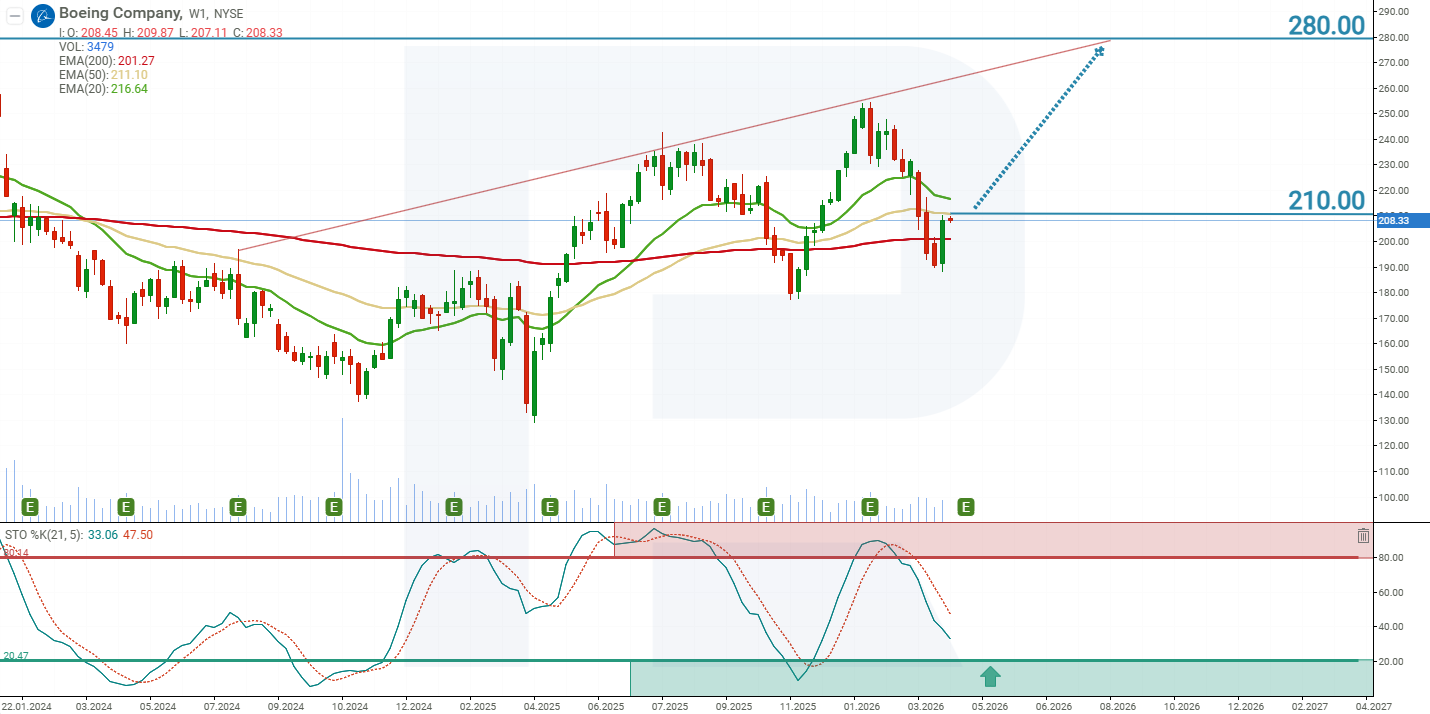
- The 200-day moving average (MA200) sits below the current price, confirming the prevailing uptrend.
- False breakdowns of the 200-day moving average signal strong buyer interest in Boeing shares during sharp pullbacks.
- Stochastic is approaching the oversold zone, signaling that the correction may conclude soon and a new upward wave may begin.
- Key entry trigger: a breakout above the MA50 near 210 USD on above-average volume. Entering before this confirmation is premature, as the probability of the Stop Loss being triggered is elevated.
- Primary upside target: resistance at 280 USD.
Sample Trading Strategy for Boeing Stock
Below is a sample trading strategy for BA shares. This example is for educational purposes only and does not constitute investment advice. Investors should assess their own risk tolerance independently.
| Parameter | Value |
|---|---|
| Entry Point | Breakout above the 50-day MA at 210.00 USD per share |
| Take Profit | Price reaching the resistance level at 280.00 USD per share |
| Stop Loss | Break below 187.00 USD — cancels the bullish signal |
| Risk / Reward Ratio | 1 : 3 — potential profit is 3× the risk |
| Position Size | No more than 3% of account |
Sample Calculation for 10 BA Shares
| Scenario | Calculation | Result |
|---|---|---|
| Buy 10 shares at 210 USD | 10 × 210 USD | 2,100 USD |
| If target reached (280 USD) | (280 − 210) × 10 | +700 USD (+33.3%) |
| If stop triggered (187 USD) | (210 − 187) × 10 | −230 USD (−10.9%) |
| Risk / Reward | 230 / 700 | 1 : 3 |
Trade with RoboForex MobileTrader
Live charts, deposits and withdrawals, analytics and copy trading — all in one app.
Risks
Like any trade idea, this scenario carries key risks that must be considered before making a decision.
- Contract risk. The April agreement between Boeing, the Pentagon, and Lockheed Martin remains a framework deal. Until it transitions into full multi-year contracts, a portion of future cash flows remains unconfirmed — meaning the market may be overestimating how quickly this news translates into real revenue and profit.
- Commercial segment risk. Even with strong growth in the defense division, Boeing's stock performance still depends heavily on the health of its commercial aviation business. If the company fails to stabilize production, aircraft deliveries, and commercial segment profitability, the defense tailwind may not be enough to sustain a durable rally in the shares.
- Geopolitical risk. Current demand for missile defense systems is largely driven by elevated Middle East tensions. If the conflict de-escalates rapidly, urgent defense procurement by the U.S. and its allies could slow over time — weakening expectations for Boeing's defense revenue growth.
Conclusion
For Boeing, this deal could be a major long-term boost. It makes the company much stronger in a key part of the defense market: protecting against ballistic missiles, cruise missiles, drones, and hypersonic weapons. This is especially important right now, given recent strikes from Iran and the growing need for U.S. allies to upgrade their air defense systems.
For the stock market, this is a reason to take a fresh look at Boeing’s defense business. If the company can turn its growing list of orders into steady profits, and if investors see that the demand for Patriot systems is here to stay, it could provide strong support for Boeing (BA) stock in the coming months.
From a technical standpoint, the Stochastic indicator is approaching the oversold zone. This often means the recent price drop is almost over and the stock could start moving up again soon.
* The information in this article reflects the personal opinions of the authors. It should not be construed as trading advice or a call to action. The authors and RoboForex bear no responsibility for trading results based on the recommendations and reviews contained in this material. Past performance is not a guarantee of future results. Trading stocks and CFDs involves a high risk of capital loss.