What Is an Economic Calendar and Why Every Trader Should Use It
17 minutes for reading
As Warren Buffett once said, information is the key to success in the market. In trading, this principle holds especially true. A trader who knows in advance when major macroeconomic data will be released gains a significant edge and can plan trades with less risk. In this article, we explain how to effectively integrate the economic calendar into your trading practice.
In Brief
- How inflation, employment, GDP, and central bank decisions affect financial markets.
- What to do when actual data differs from the forecast.
- Three practical strategies for trading the news.
What Is an Economic Calendar and Why Do You Need It
Imagine a trader opens a buy position on EUR/USD, and the price moves steadily higher. A few minutes later, US labour market data is released. The numbers come in significantly stronger than expected, and the dollar surges. Within just a few minutes, the market reverses and travels 100 pips in the opposite direction.
In moments like this, market dynamics can accelerate sharply on the back of news flow. To navigate these situations more effectively and understand when volatility may spike, it is important to track key events in the economic calendar in advance.
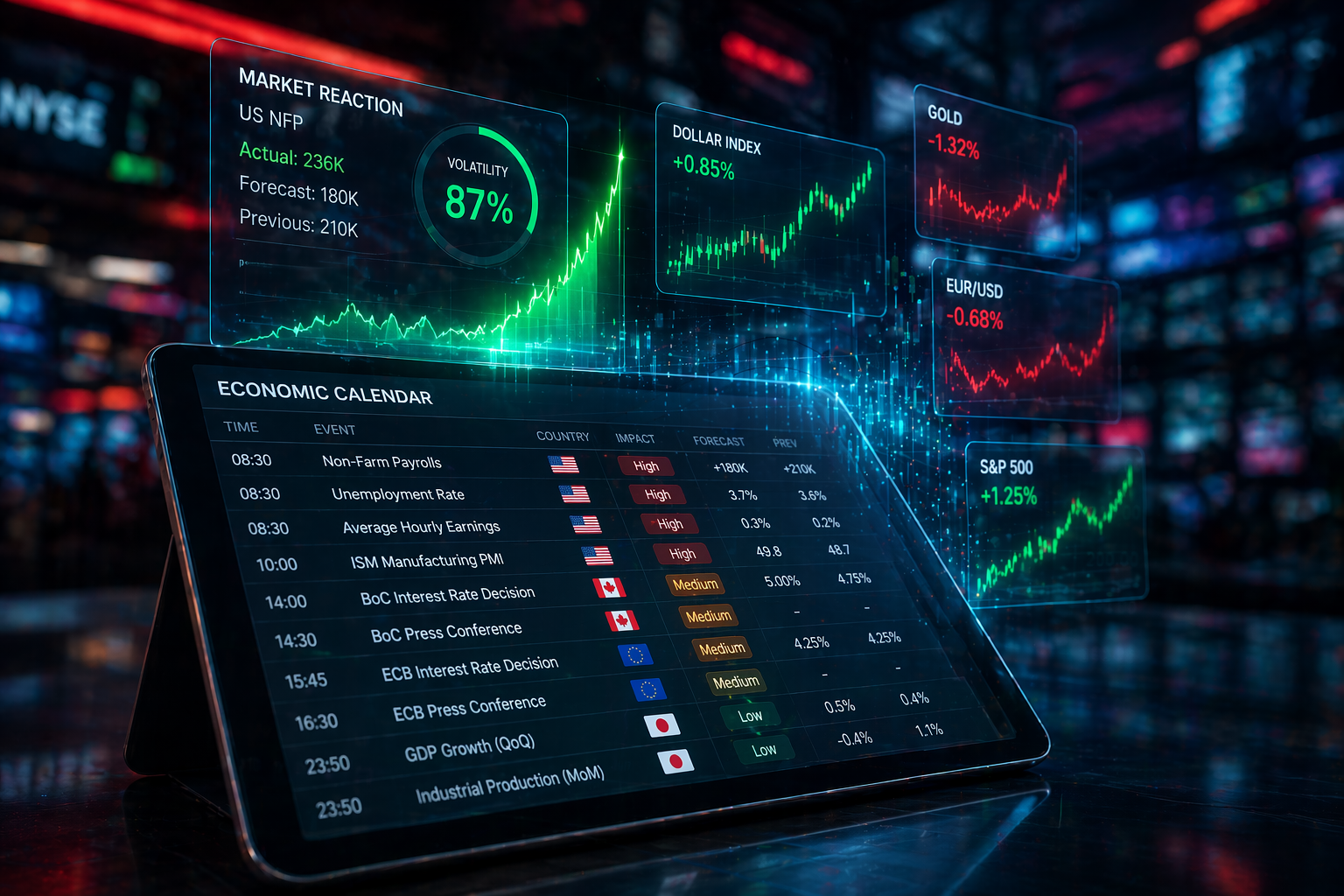
An economic calendar is a schedule of upcoming macroeconomic data releases: when the inflation report comes out, when a central bank will announce its rate decision, when GDP or employment figures are published. For each event, the calendar also shows the analyst consensus forecast and the previous reading.
Events in the calendar are ranked by importance. The most significant ones are highlighted in red — these are the releases that most often trigger sharp market moves. A trader who knows about these events ahead of time can plan accordingly: enter the market before the release, wait for the announcement and enter afterwards, or close positions entirely to protect capital.
Simple Principle
The economic calendar does not tell you which direction the market will move. But it tells you exactly when the market may move sharply. That alone is half the work.
Instant Access to Global Markets with RoboForex MobileTrader
How to Read the Data: Forecast, Actual, Surprise
Every event in the calendar has three numbers: the forecast, the previous reading, and the actual figure (published after the release). The gap between the forecast and the actual result determines how strongly the market will react.
When data matches the forecast, the market typically barely moves — expectations were already priced in. When data comes in significantly better or worse than expected, this is called a surprise. In such cases, a move can happen within seconds.
The previous reading matters too. If inflation has beaten forecasts for three consecutive months, that is already a trend, and the market reacts even more sharply. If data unexpectedly drops after two months of growth, that is a reversal signal that can shift the market for an extended period.
| Situation | Actual vs Forecast | Typical Market Reaction |
|---|---|---|
| Positive surprise | Actual significantly better | Sharp move in favour of the currency. Momentum entry along the trend is possible. |
| In line with expectations | Actual ≈ forecast | Minimal reaction. Direction driven by other factors. |
| Negative surprise | Actual significantly worse | Sharp move against the currency. Stop-losses triggered, liquidity drops. |
5 Events That Move the Market the Most
The economic calendar contains dozens of events every week. Most of them the market barely notices. But five categories of releases consistently generate the strongest moves — these are the ones every trader needs to know and monitor without fail.
| Event | Instruments Affected | Importance |
|---|---|---|
| Central Bank Rate Decision (Fed, ECB, Bank of England) | EURUSD, GBPUSD, USDJPY, indices | High |
| Consumer Price Index (inflation data) | EURUSD, GBPUSD, gold, DXY | High |
| Nonfarm Payrolls (US employment data) | EURUSD, GBPUSD, USDJPY, S&P 500 | High |
| GDP (economic growth data) | National currency, indices | High |
| Central Bank Governor Speeches | Depends on speaker: USD, EUR, GBP, JPY | High |
Central Bank Rate Decisions
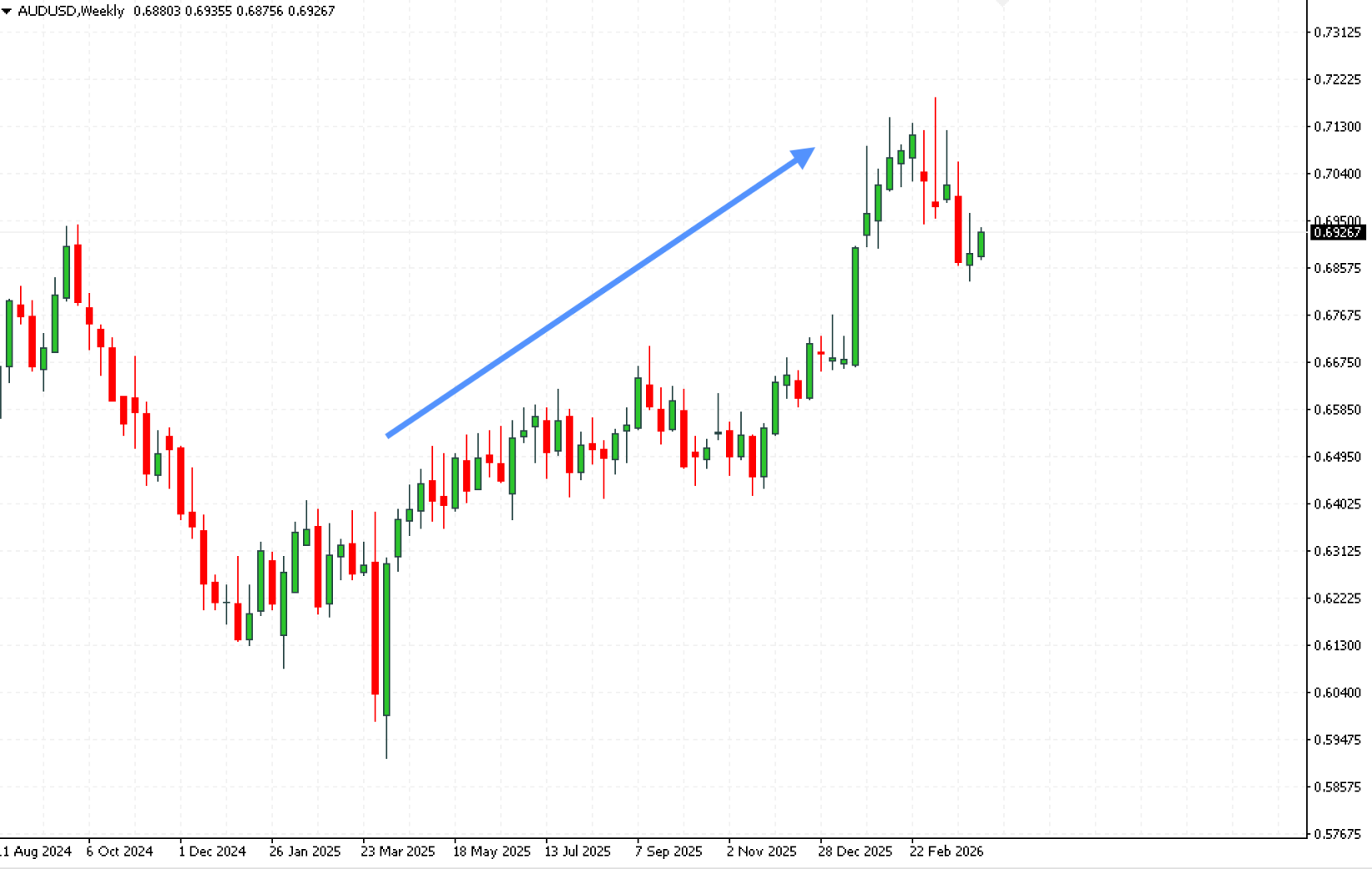
When a central bank raises its key interest rate, money in that country becomes more expensive, the currency strengthens, and becomes more attractive to investors. Capital flows to where returns are higher. That is why a rate hike typically strengthens a currency, while a rate cut weakens it.
Example
03.02.2025 — The Reserve Bank of Australia raises rates while the Fed is already running a looser monetary policy ⇾ investors shift capital into the Australian dollar ⇾ AUDUSD rises.
Consumer Price Index — Inflation Data
Inflation is the central bank's primary argument when making a rate decision. If inflation comes in above forecast, the market expects a rate hike ⇾ the currency strengthens. If below — a cut is anticipated ⇾ the currency weakens.
Importantly, the reaction often begins before the rate decision itself. If the market had previously priced in two rate cuts but after the CPI release only one is expected, the dollar can move noticeably higher on the very day the inflation data is published.
Example
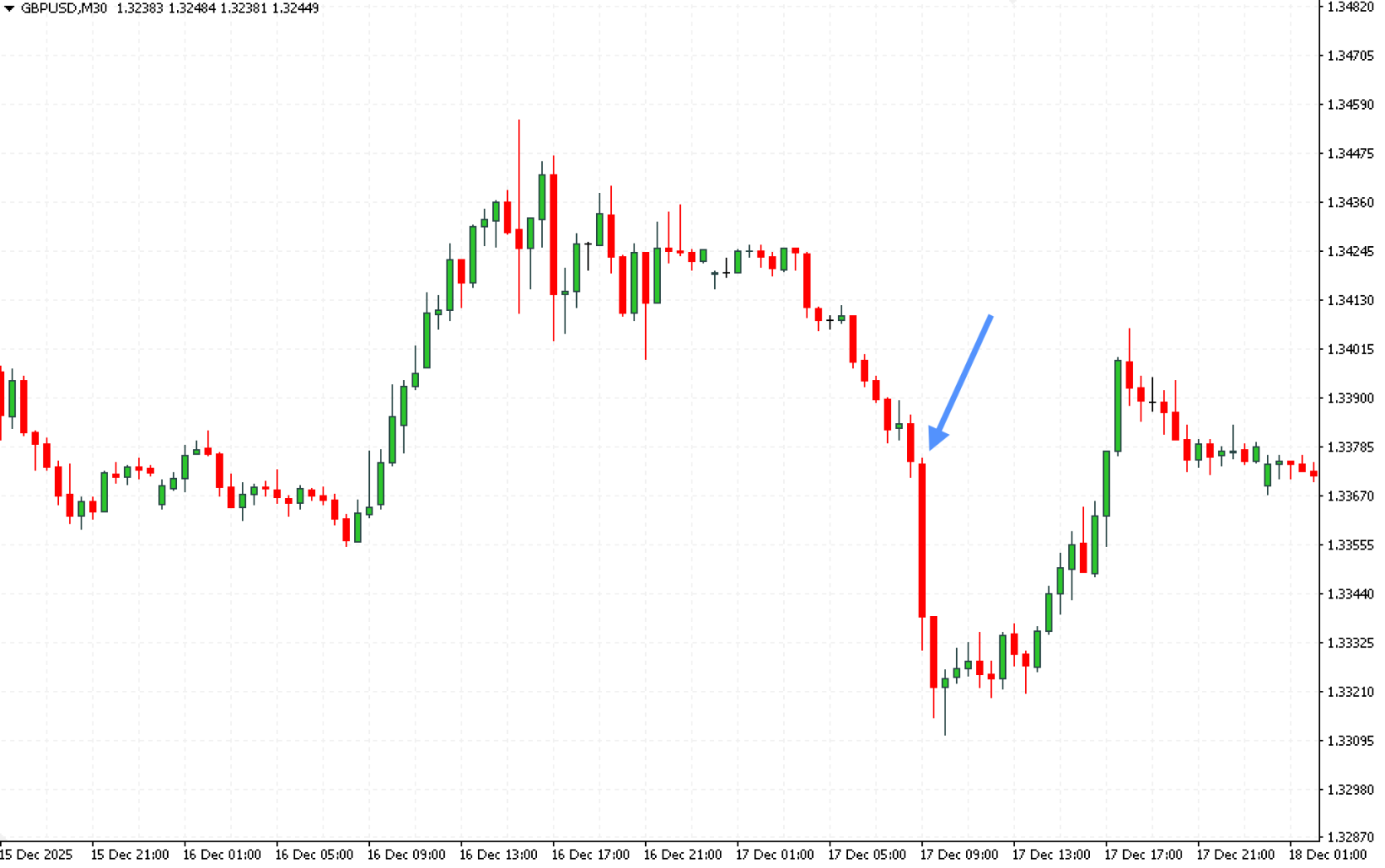
17.12.2025 — UK CPI forecast was 3.5%, actual came in at 3.2% ⇾ the market strengthens expectations for an earlier Bank of England rate cut ⇾ sterling becomes less attractive to investors, and GBPUSD falls immediately.
Nonfarm Payrolls — US Labour Market Report
Released on the first Friday of every month. It shows how many jobs were created in the US during the month (excluding agriculture). It is one of the key indicators of economic health — and one of the most unpredictable.
- Data stronger than expected ⇾ the dollar strengthens, as the market reads it as a signal of economic growth.
- Data weaker than expected ⇾ pressure on the dollar, as expectations for a rate cut rise.
Example
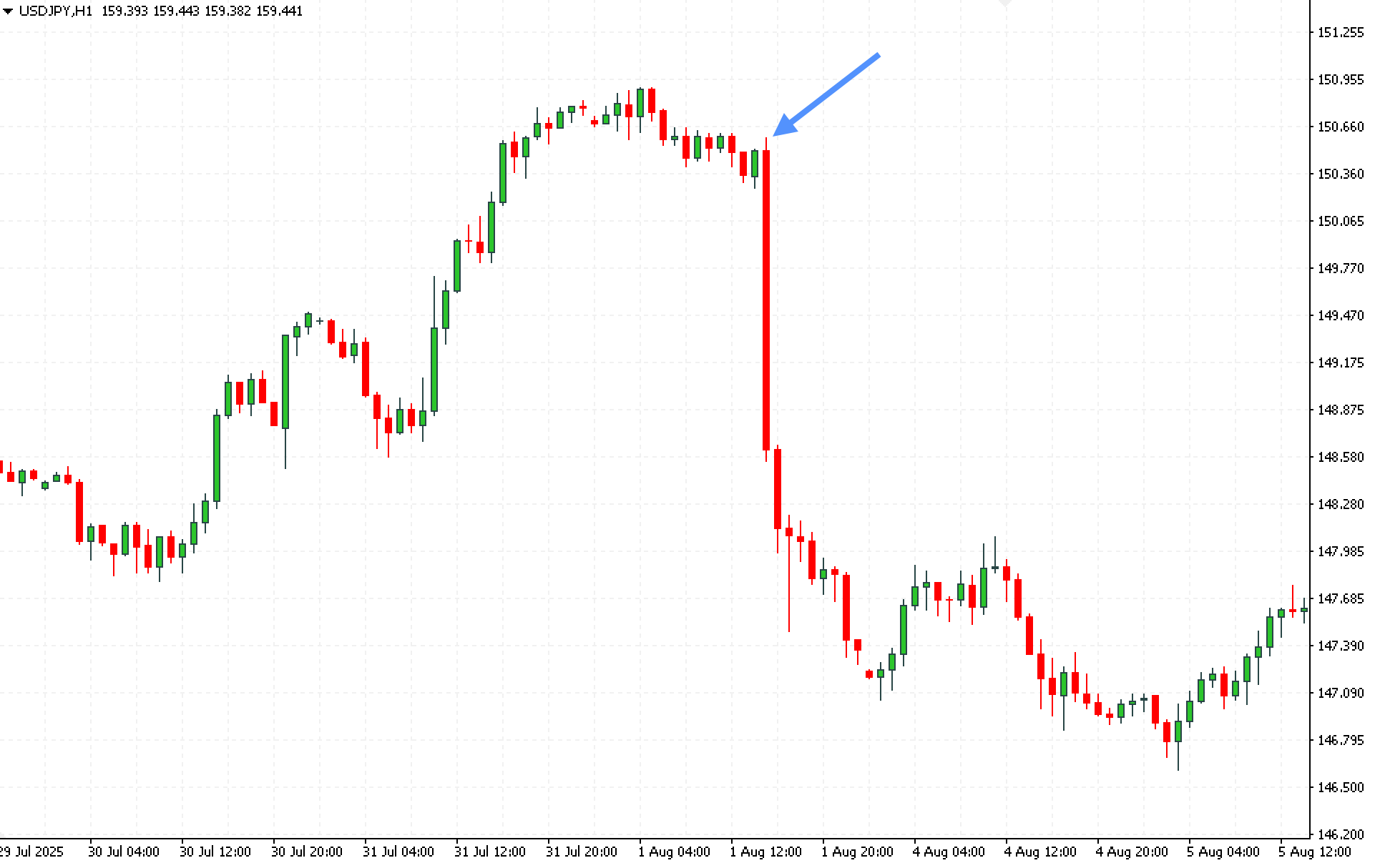
01.08.2025 — NFP forecast: 105k jobs; actual: 73k (with May–June data revised down by 258k) ⇾ USD drops sharply, USDJPY falls more than 190 pips within minutes of the release.
GDP
GDP shows how much a country's economy grew or contracted in a given quarter. If growth slows or turns negative, investors become nervous and may exit assets tied to that country. A sharp divergence from the forecast triggers a strong market reaction.
Example
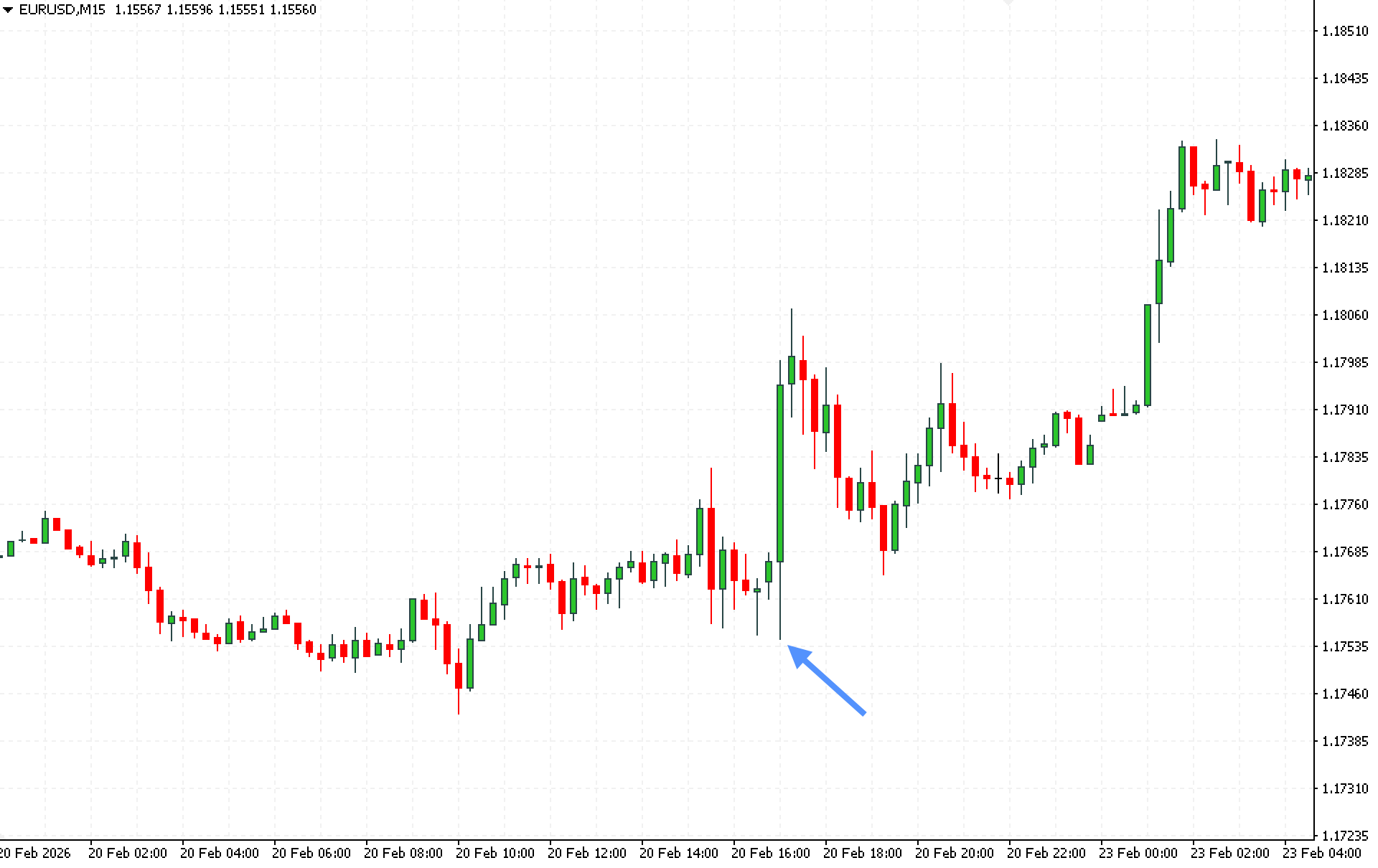
20.02.2025 — US quarterly GDP: forecast +3.0%, actual +1.4% ⇾ investors revise Fed policy expectations towards an earlier rate cut → the dollar weakens ⇾ EURUSD rises.
Central Bank Governor Speeches
Sometimes a single phrase from the Fed or ECB chief moves the market more than an entire batch of statistics. Any hint at a rate hike or cut in a speech triggers an immediate market response. The Bank of Japan deserves special attention: it regularly conducts direct currency interventions when the yen moves too far in either direction.
Example
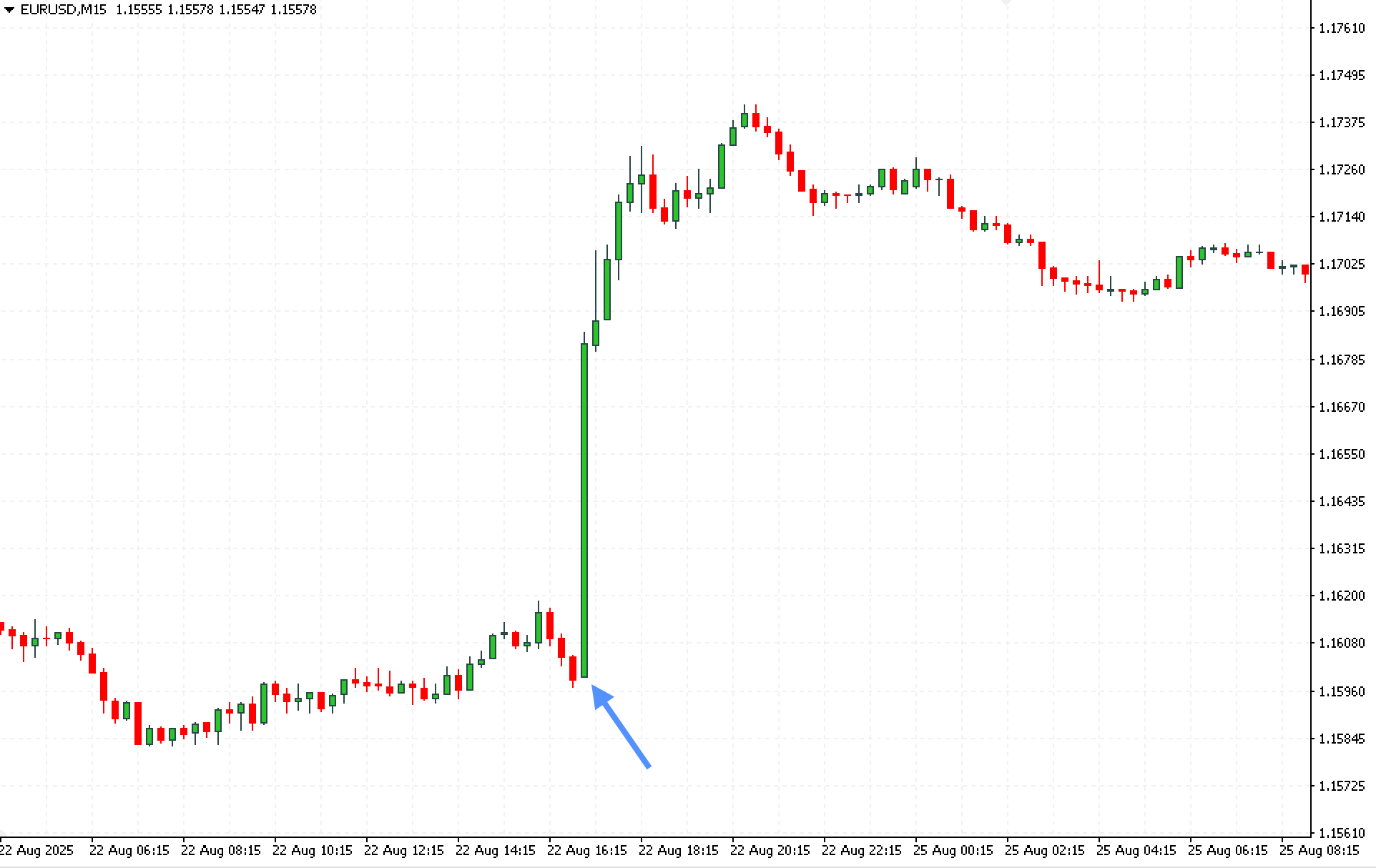
22.08.2025 — the Fed Chair at a press conference signals the regulator appears ready to cut rates ⇾ the market reads this as a dovish signal ⇾ the US dollar falls sharply.
Open a Trading Account at RoboForex
Swap-free accounts, spreads from 0, and execution in 0.01 seconds.
3 Strategies for Trading the News
Knowing when a news release is coming is only the first step. What matters next is knowing what to do with that information. Here are three approaches traders use in practice.
Strategy 1
Breakout Trading
20–30 minutes before the data release, the trader looks at the chart and identifies the nearest support and resistance levels. Two pending orders are then placed: one to buy just above resistance, another to sell just below support (offset of 10–20 pips). When the news hits and the market moves sharply in one direction, the relevant order triggers automatically. The other is cancelled manually. This strategy works well around NFP and Fed rate decisions.
Strategy 2
Trading in the Direction of the Trend
When a clear trend is already in place, news often accelerates it rather than reversing it. The trader checks: if price is above the EMA-85 on the daily chart, the trend is up. Strong data in line with the trend serves as a signal to add to the position. Sometimes a weak release triggers a brief pullback — creating an opportunity to enter at a better price in the direction of the main move.
Strategy 3
Buy the Rumour, Sell the News
Markets often begin moving before the release itself — when investors start pricing in positive expectations. Once the data is published, some traders close their profitable positions. As a result, even good data can lead to a pullback. Understanding this mechanism, a trader can close the position ahead of the release or use the pullback as a re-entry point.
The key in all three approaches is understanding the situation, not the speed of reaction to the numbers. When a trader knows the forecast, sees the current trend, and understands market expectations — decisions come faster and more accurately.
The up-to-date economic calendar and market analysis are available in the Market Analysis section on the RoboForex website.
3 Rules to Protect Your Capital Around News
Trading around news releases is a high-risk zone. The market can move sharply in either direction, and spreads temporarily widen. Here are three rules that help preserve capital.
🟡 Rule 1 — Do Not Open New Trades 30 Minutes Before a Major Release
Even when a trend looks obvious, a news release can break it instantly. It is better to wait for the publication, observe the market's reaction, and enter in a clearer environment. Often, the market provides a much better entry point after the news than before it.
🟢 Rule 2 — Reduce Position Size If Already in a Trade
If you are already in a trade and a major news release is just minutes away, close part of the position. Lock in at least some profit. If the market moves against you, a smaller position means a smaller loss. Capital preservation matters more than squeezing every pip out of a single trade.
🔴 Rule 3 — Exit Completely Before the Most Unpredictable Events
NFP, the Fed rate decision, an ECB chief speech — these are events where even experienced traders cannot confidently predict the market's reaction. Sometimes the right move before these releases is simply to close all positions. Once the initial reaction subsides and the market establishes a direction, new entries can be made in a calmer environment.
In the long run, protecting capital always matters more than trying to catch a single sharp move.
Trade with RoboForex MobileTrader
Live charts, deposits and withdrawals, analytics and copy trading — all in one app.
Real-Time Market Insights for RoboForex Clients: A Smarter Calendar
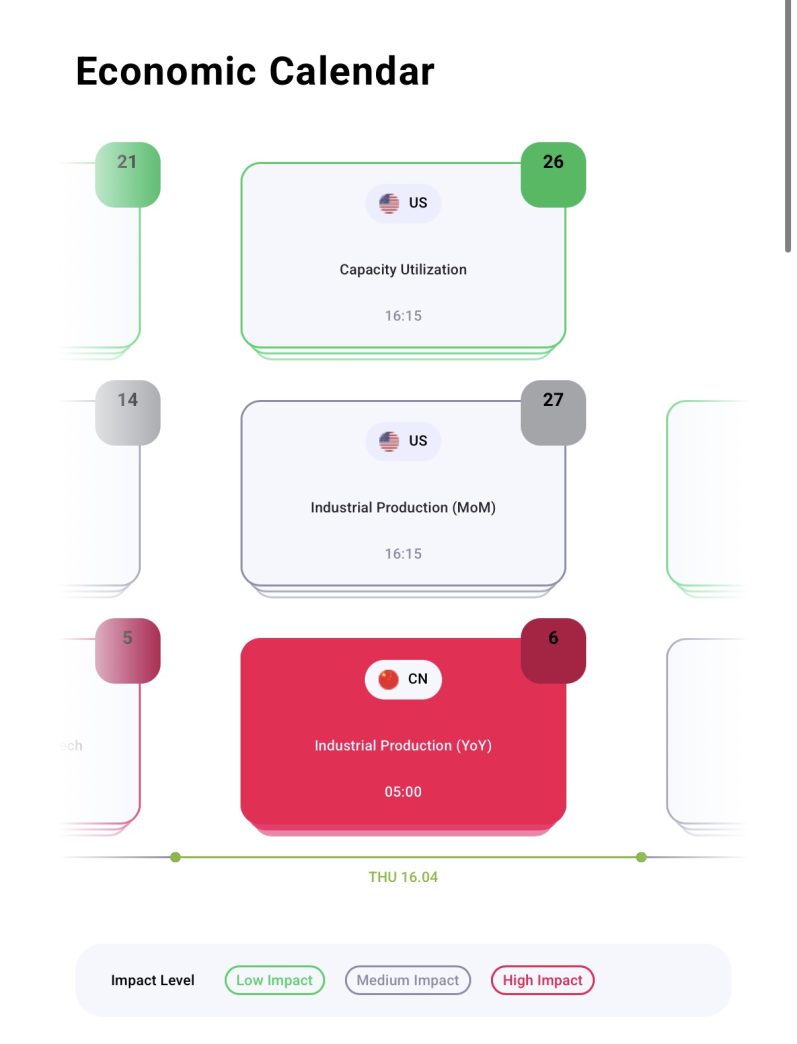
A standard economic calendar shows you the date and time of an event. Real-Time Market Insights offers an enhanced economic calendar that pairs each event with analysis, helping traders understand in advance what a release may mean for the market.
AI Filtering
Only the Events That Matter
The algorithm automatically highlights events that genuinely affect your instruments. No need to manually sort through hundreds of releases.
Forecasts in Advance
Plan Before the Data Drops
Exclusive analytical insights let you build your trading strategy before a release — not just react after the fact, but prepare in advance.
Entry and Exit Points
Data-Driven Trade Ideas
The tool highlights optimal entry and exit points around key economic events, based on historical market reaction patterns.
Multi-Asset Coverage
Data from 100+ Countries
Macroeconomic events from more than 100 countries in one place. Currencies, metals, oil, indices — all in a single data feed.
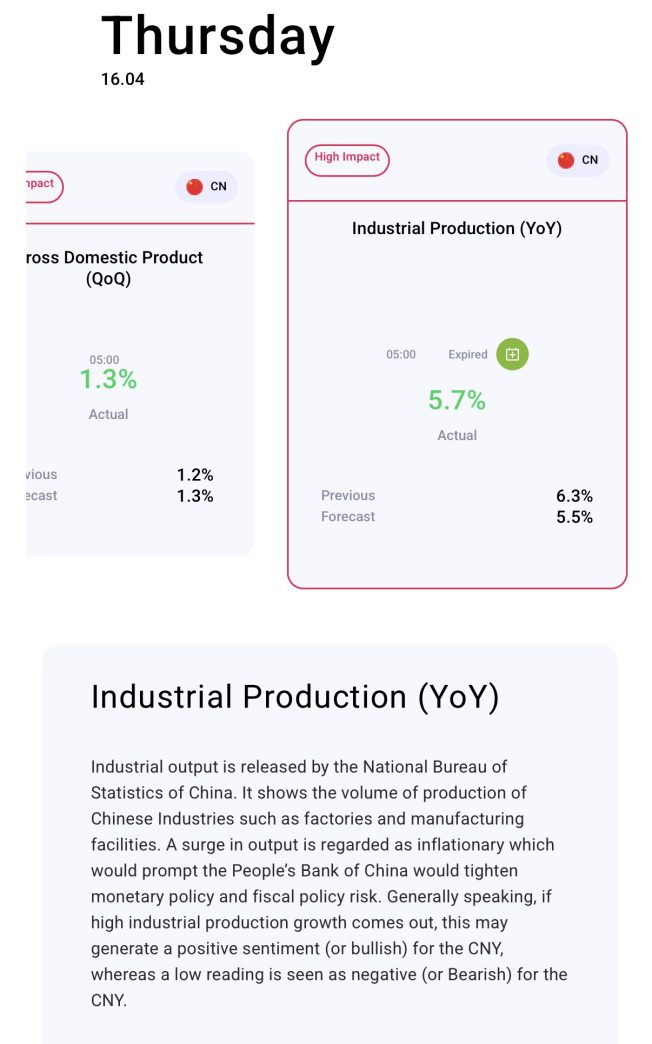
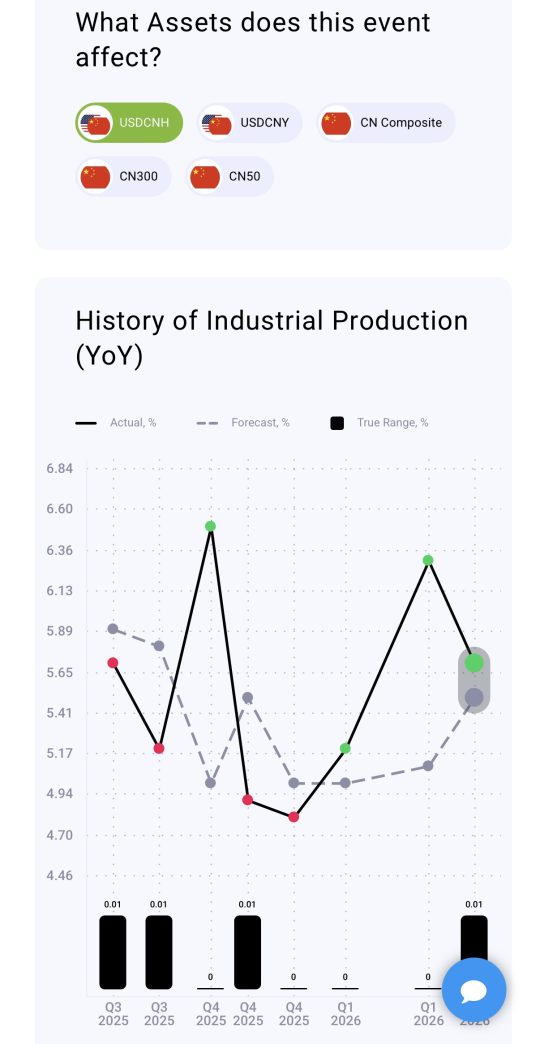
Standard Calendar vs. Real-Time Market Insights
| Feature | Standard Calendar | Real-Time Market Insights |
|---|---|---|
| Event date and time | ✓ | ✓ |
| Forecast and previous value | ✓ | ✓ |
| AI filtering by instrument | ✗ | ✓ |
| Predictive insights before the release | ✗ | ✓ |
| Entry and exit points | ✗ | ✓ |
| MT5 integration | ✗ | ✓ |
| Data from 100+ countries | ✗ | ✓ |
How This Helps the Trader
Instead of manually tracking dozens of events and guessing market reactions, the trader receives ready-made analytical cues: which events matter for their specific instruments, when to enter and exit, and what is already priced in before the data is released.
Next step: open Real-Time Market Insights right now (available in the Members Area for RoboForex clients) — see which events are scheduled this week, which ones are flagged as significant for your instruments, and what the analysis says about the likely market reaction.
Conclusion
The economic calendar is a tool that gives traders an informational edge: it allows you to anticipate spikes in volatility in advance and adapt your strategy in time.
Check the calendar every morning. Mark high-importance events for the coming days. If you have an open position ahead of a major release, decide in advance what you will do: hold with a reduced position size, close part of it, or exit completely.
Traders who ignore the economic calendar are trading blind. Those who use it manage risk consciously and find opportunities where others book losses.