Berkshire Hathaway Buys Google Amid AI Boom. Why Did the Fund Bet on GOOGL?
15 minutes for reading
Berkshire Hathaway has sharply increased its position in Alphabet Inc, the parent company of Google. In the first quarter of 2026, the fund tripled its GOOGL stake, making Google one of the largest bets in its portfolio. We break down why Berkshire chose Alphabet and what this means for GOOGL shares.
In Brief
- In Q3 2025, Berkshire Hathaway purchased Alphabet shares for the first time.
- In Q1 2026, the fund raised its Alphabet stake from 17.85M to 57.83M shares.
- The Google–Blackstone joint venture strengthens the investment case for Alphabet.
- 48 out of 54 analysts rate GOOGL shares as a Buy.
- Stochastic signals a possible correction with entry point near the 350 USD level.
Trade Idea Parameters
Below are the specific parameters for the Alphabet trade idea. The ticker for trading via RoboForex MobileTrader and MT5 on RoboForex is GOOGL.
| Parameter | Value |
|---|---|
| Instrument | Alphabet Inc (NASDAQ: GOOGL) |
| Ticker in MobileTrader / MT5 | GOOGL |
| Idea Date | May 22, 2026 |
| Time Horizon | 1–6 months |
| Direction | ↑ Buy (Long) |
| Entry Level (trigger) | 350 USD |
| Take Profit | 492 USD |
| Stop Loss | 338 USD |
| Position Size | No more than 3% of account · Medium risk |
Instant Access to Global Markets with RoboForex MobileTrader
When Berkshire First Invested in Alphabet
Berkshire Hathaway came to Alphabet relatively late. The fund did not buy Google shares in the early stages, when the company was just becoming a leader in the online ads market, and it stayed on the sidelines for years even after Alphabet had grown into one of the largest technology companies in the world.
The first disclosed purchase appeared only in Q3 2025, already during the period of intense market interest in artificial intelligence. According to the 13F filing submitted to the SEC on 14 November 2025, Berkshire held 17.85 million Alphabet shares as of 30 September 2025. The position was valued at approximately 4.3 billion USD, and Alphabet immediately ranked tenth among the largest US stocks in Berkshire's portfolio.

Where Alphabet Stands in Berkshire’s Portfolio
When Berkshire first disclosed its Alphabet position in Q3 2025, Google immediately became a notable part of the fund's portfolio. A dramatic shift came in Q1 2026: Berkshire raised its Alphabet stake to 57.83 million shares, with the position's estimated value exceeding 16.6 billion USD by the end of the quarter.
After that, Alphabet climbed to seventh place in Berkshire's portfolio, overtaking Chubb Limited (NYSE: CB), Moody's Corp (NYSE: MCO), and Kraft Heinz Co (NASDAQ: KHC). Google has joined the ranks of the fund's largest bets on the US market.

Why Berkshire Chose Alphabet
Google today is a large ecosystem that spans search advertising, YouTube, Android, Google Cloud, subscription services, Gemini AI models, data centres, and proprietary TPU chips. This matters to Berkshire because the fund typically seeks businesses with straightforward economics, strong competitive advantages, and the ability to generate cash flow for years to come. Below are the key strengths of Alphabet's business.
- Advertising business. In Q1 2026, Google Search & Other revenue grew 19%, while AI features in search continue to support user engagement. The core profit engine of Google is gaining new growth opportunities.
- Google Cloud. In Q1 2026, Google Cloud revenue grew 63%, and the volume of future contracted commitments exceeded 460 billion USD — a clear sign of strong demand for Google's cloud services.
- Proprietary TPU chips and data centres. The company is developing its own technological infrastructure for AI, giving it greater control over costs, performance, and scaling. Over the long term, this may become a significant competitive advantage for Google Cloud and Alphabet's AI segment.
- Cash flow. Even with heavy AI investment, Alphabet continues to generate strong free cash flow. Over the last 12 months it reached 64.4 billion USD, allowing the company to fund its growth without adding to its debt load.
- Portfolio diversification. The Alphabet purchase is part of diversifying the technology portion of Berkshire's portfolio. The fund is gradually reducing its dependence on a single large position in Apple and adding Google as a business with Ads, YouTube, Cloud, and AI infrastructure.
Google and Blackstone Launch an AI Company
An additional argument for Alphabet came from the announcement of a joint venture between Google and Blackstone. The two companies are creating a new US AI company that will give clients access to Google's data centres and proprietary TPU chips. Blackstone will contribute an initial 5 billion USD, with the first 500 MW of capacity targeted for launch in 2027. Total investment could grow to 25 billion USD including debt financing.
For Alphabet, the deal matters on several levels. First, it strengthens Google's position in the cloud business. Second, it demonstrates that Google's TPU chips are becoming a standalone commercial product. Third, Blackstone's participation reduces the load on Alphabet's balance sheet, since a significant portion of infrastructure capital comes from an external partner. The new company also intensifies competition with Nvidia and offers clients an alternative route to AI compute capacity.
Why the Market Is Watching This Purchase So Closely
Berkshire Hathaway rarely makes sharp increases to large positions in technology companies. The fund typically favours businesses with straightforward economics, strong cash flow, and durable competitive advantages. The timing of the purchase is particularly significant: Berkshire began buying Alphabet shares during a period of intense investor interest in artificial intelligence — when the market was actively debating whether Google could defend its search business against new AI services.
In other words, the fund entered the position not at an early stage of the company's development, and not after a sharp drop in the share price, but at a moment when high expectations around AI had already formed — which is uncharacteristic for Berkshire Hathaway.
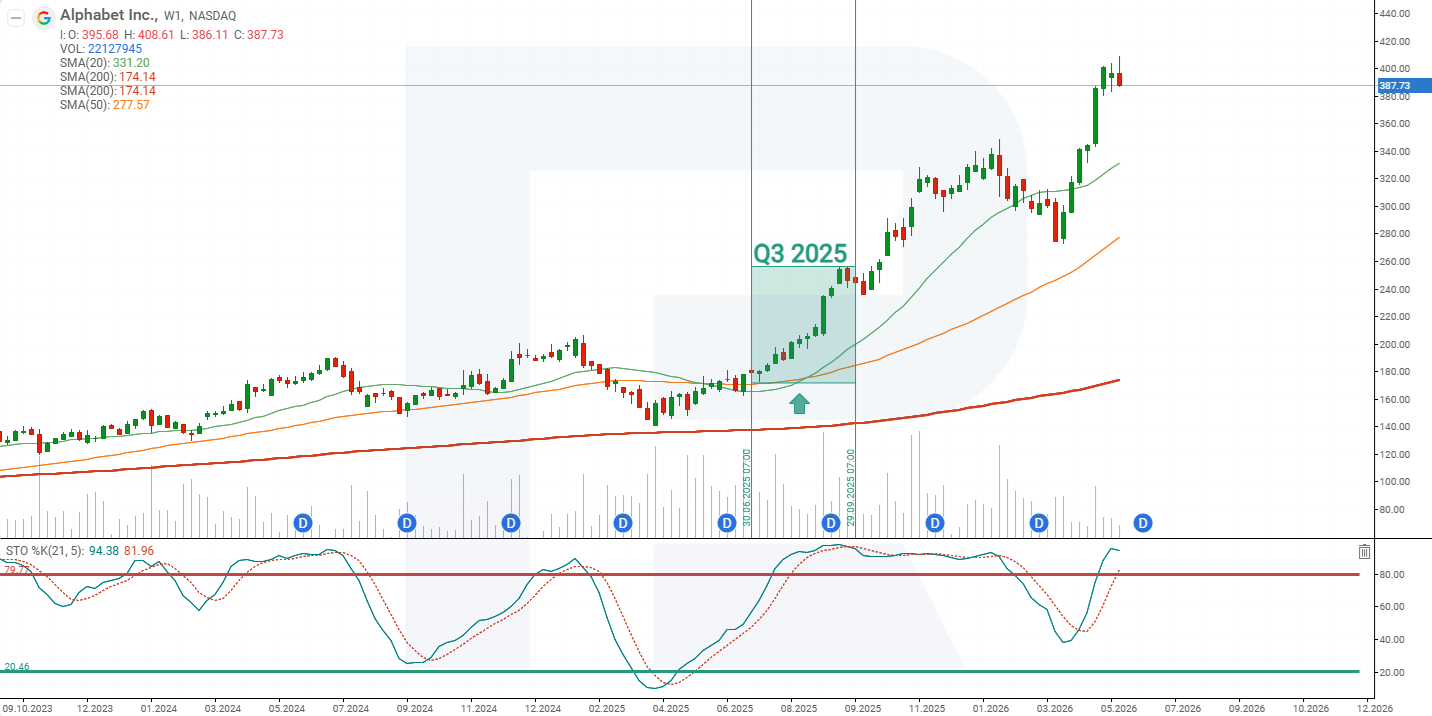
For the market, this is an important signal: Alphabet is increasingly perceived as a large, resilient business where artificial intelligence can serve as an additional growth driver. Berkshire's purchase is a strong reputational endorsement for the company.
Open a Trading Account at RoboForex
Swap-free accounts, spreads from 0, and execution in 0.01 seconds.
GOOGL Analyst Ratings
As of May 2026, Barchart analyst ratings for Alphabet shares reflect a near-unanimous consensus: 48 out of 54 tracked analysts rate GOOGL as a Buy and 6 as Hold. There are zero Sell ratings.
Buy — 48
Hold — 6
48 out of 54
analysts recommend buying GOOGL (89%)
Hold
6 (11%)
Sell
0 (0%)
Average Target Price
430.53 USD
Maximum Target Price
515.00 USD
48 out of 54
analysts recommend buying GOOGL (89%)
Hold
6 (11%)
Sell
0 (0%)
Average Target Price
430.53 USD
Maximum Target Price
515.00 USD
GOOGL Technical Analysis
On the daily timeframe, GOOGL shares are trading above the 200-day Moving Average, confirming that the long-term uptrend remains intact. However, the Stochastic indicator has moved into overbought territory and is signalling a possible correction. This correction could play out either as a price decline or as an extended period of sideways trading within the range that has already formed between the 404 and 384 USD levels.
Fibonacci levels help identify how far GOOGL could pull back during a correction and also mark the target for the subsequent recovery. If the correction develops as a price decline, a more conservative entry can be considered near the 350 USD level — this level offers a more attractive risk-to-reward ratio.
The base scenario calls for a test of the 350 USD level followed by a rebound and a rally to 492 USD. Given Berkshire Hathaway's purchase of Alphabet, the 492 USD target should be viewed as the nearest reference point rather than the ceiling for long-term growth.
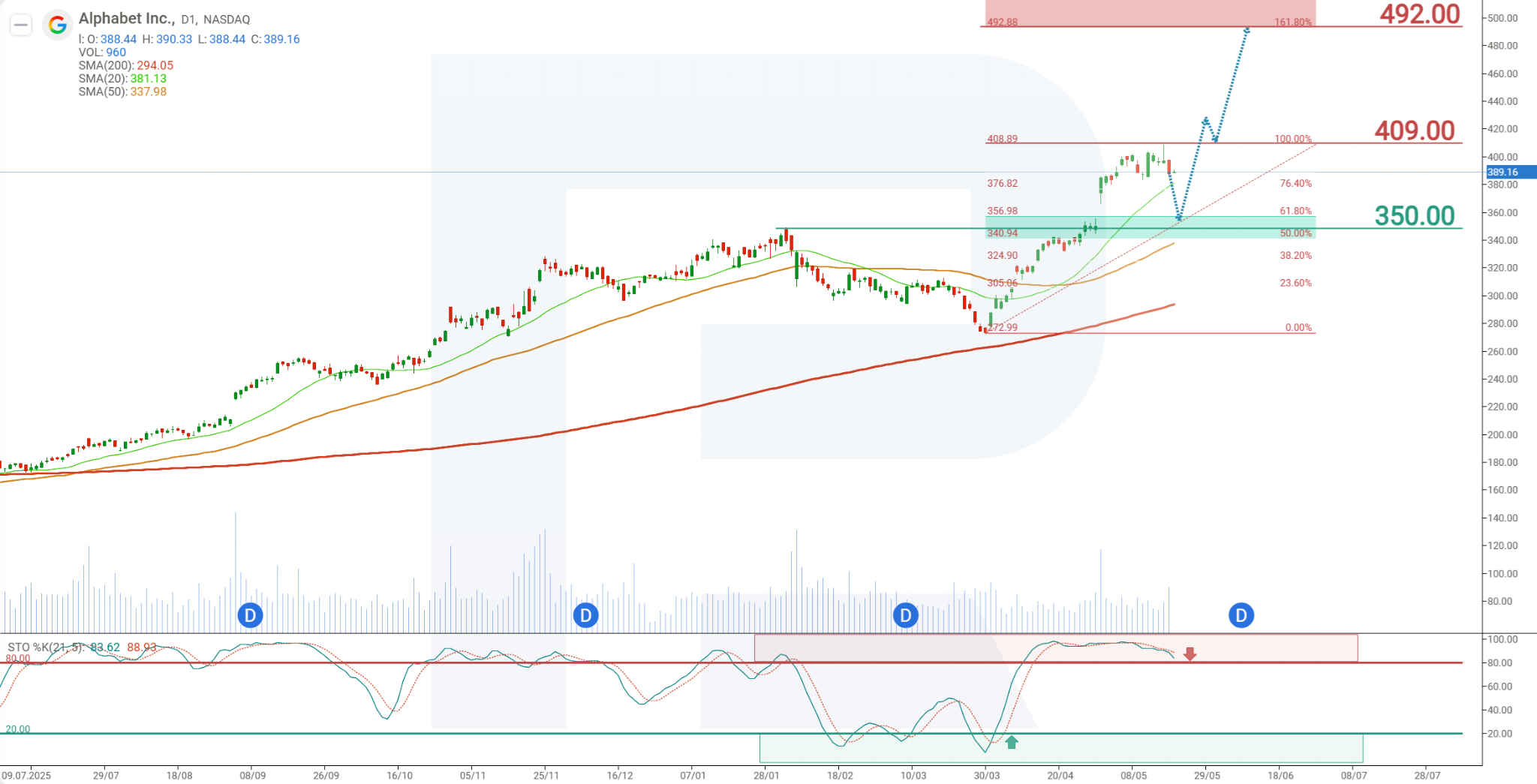
- The 200-day Moving Average (MA200) remains well below the current price, confirming the strength of the long-term uptrend.
- Stochastic is in the overbought zone, pointing to a potential corrective decline in GOOGL.
- Fibonacci levels identify an entry point with a more favourable risk-to-reward ratio near 350 USD.
- The 492 USD level is the nearest upside reference point, not the ceiling for the long-term move.
Sample Trading Strategy for GOOGL Shares
Below is a sample trading strategy for GOOGL shares. This example is for educational purposes only and does not constitute investment advice. Investors should assess their own risk tolerance independently.
| Parameter | Value |
|---|---|
| Entry Point | Buy at 350 USD |
| Take Profit | 492 USD |
| Stop Loss | 338 USD — below the 50% Fibonacci level |
| Risk / Reward Ratio | 1 : 11.8 |
| Position Size | No more than 3% of account |
Sample Calculation for 10 GOOGL Shares
| Scenario | Calculation | Result |
|---|---|---|
| Buy 10 shares at 350 USD | 10 × 350 USD | 3,500 USD |
| If target reached (492 USD) | (492 − 350) × 10 | +1,420 USD (+40.5%) |
| If stop triggered (338 USD) | (350 − 338) × 10 | −120 USD (−3.4%) |
| Risk / Reward | 120 / 1,420 | 1 : 11.8 |
A risk-to-reward ratio of 1:11.8 is highly attractive for position trading. Keep in mind that markets are volatile: GOOGL shares can move both for and against an open position.
Risks
Like any trade idea, this scenario carries key risks that should be considered before making a decision.
- High valuation after the rally. If the market has already priced in strong growth from Google Cloud and the AI segment, further upside potential may be limited.
- Antitrust pressure. Alphabet remains under close regulatory scrutiny, particularly in search, advertising, and its broader ecosystem of services.
- Rising AI spending. Data centres, servers, chips, and model development require enormous investment. If the returns on these outlays fall short of expectations, margins could come under pressure and weigh on the share price.
- Competition. Alphabet competes with Microsoft, Amazon, and Meta, as well as companies such as CoreWeave that are building infrastructure on Nvidia hardware. The new Blackstone venture still needs to demonstrate sustainable demand and economic viability.
Conclusion
Berkshire Hathaway's purchase of Alphabet shares is a strong positive signal for the market and for many investors, transactions of this size from Berkshire serve as a quality endorsement for the stock, and interest in Google shares from other large funds could grow as a result.
An additional factor is that Alphabet paid its first-ever dividend in 2024, making the company more attractive to long-term investors who value stable cash flow. The Google–Blackstone joint venture also strengthens Alphabet's long-term investment case: the company is building infrastructure well ahead of expected demand for its AI platform, with Blackstone's participation allowing Alphabet to scale its data-centre business using external capital rather than stretching its own balance sheet.
From a technical analysis standpoint, GOOGL shares maintain a strong long-term uptrend, though indicators point to a likely near-term correction. The 492 USD target should be viewed as the nearest reference point rather than the ceiling for long-term appreciation. Should Alphabet continue to strengthen its position in the AI market, sustained interest from long-term investors is likely to follow.
This material is provided for informational purposes only and does not constitute investment advice or a recommendation to execute any transaction. Trading financial instruments carries a high risk of loss. Past results do not guarantee future performance. Before making investment decisions, please consult an independent financial adviser.