Eli Lilly Strengthens Its Weight Loss Pipeline. Why Retatrutide Could Be the Next Growth Driver for LLY
16 minutes for reading
On Monday, June 8, LLY shares opened with a 2.5% gap up following the release of full Phase 3 clinical trial results for Retatrutide. This experimental weight loss drug could become Eli Lilly's next major product after Mounjaro and Zepbound — and the data are significantly stronger than anything seen from rivals.
In Brief
- Average weight loss from Retatrutide reaches 28.3% — close to the effect of bariatric surgery.
- Retatrutide could become Eli Lilly's next major drug after Mounjaro and Zepbound.
- New data strengthen Eli Lilly's competitive position against Novo Nordisk.
- 26 out of 30 analysts rate LLY shares as Buy.
- LLY's long-term uptrend remains intact; the nearest target in this trade idea is 1400 USD.
Trade Idea Parameters
Below are the specific parameters for the Eli Lilly and Company trade idea. The ticker for trading via RoboForex MobileTrader and MT5 on RoboForex is LLY.
| Parameter | Value |
|---|---|
| Instrument | Eli Lilly and Company (NYSE: LLY) |
| Ticker in MobileTrader / MT5 | LLY |
| Idea Date | June 10, 2026 |
| Time Horizon | 1–6 months |
| Direction | ↑ Buy (Long) |
| Entry Level (trigger) | 1156 USD |
| Take Profit | 1400 USD |
| Stop Loss | 1108 USD |
| Position Size | No more than 3% of account · Medium risk |
Instant Access to Global Markets with RoboForex MobileTrader
Eli Lilly’s New Record: Retatrutide Brings Weight Loss Close to 30%
The Phase 3 clinical trial of Retatrutide began on July 10, 2023. The study enrolled adults with obesity or overweight and concluded on May 1, 2026. Eli Lilly published initial summary results on May 21. The report showed that participants receiving the highest dose lost an average of 28.3% of body weight over 80 weeks. Moreover, 45.3% of patients in that group achieved a weight reduction of at least 30% — a result previously associated exclusively with bariatric (gastric reduction) surgery.
These findings gained wider attention on Saturday, June 6, at the American Diabetes Association conference, where Eli Lilly presented a more complete dataset covering obesity, type 2 diabetes, knee osteoarthritis pain, and obstructive sleep apnea. For investors, this is a meaningful signal. Eli Lilly is already one of the leading players in the obesity drug segment, and the new data show that the company can raise the efficacy bar even higher.
What Is Retatrutide
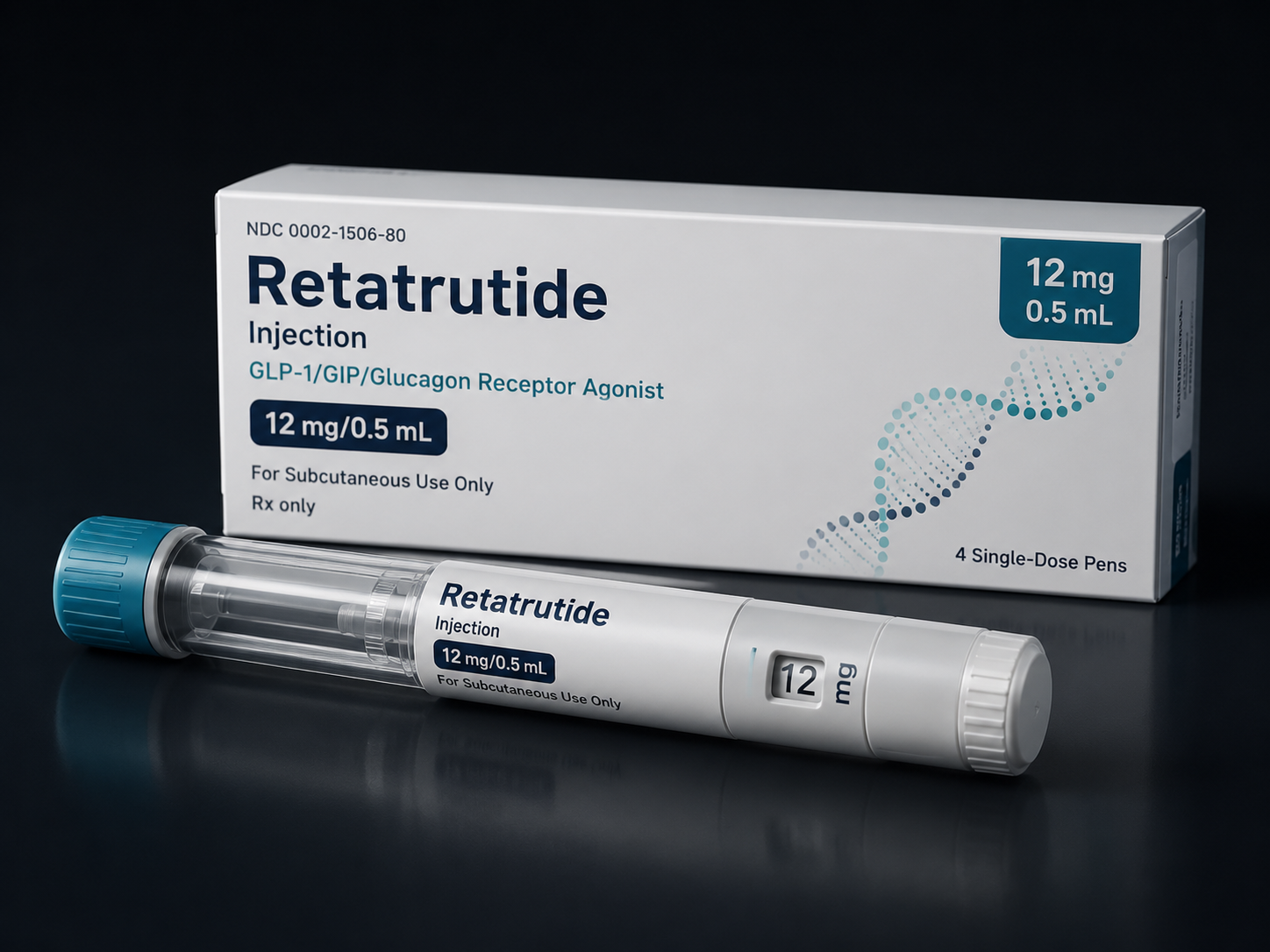
Retatrutide is Eli Lilly's experimental drug for obesity and related conditions. It is not yet an approved commercial product, but Phase 3 data already make it one of the company's most important pipeline candidates.
Its defining characteristic is its mechanism of action. Wegovy and Ozempic from Novo Nordisk are based on semaglutide and work through GLP-1. Zepbound and Mounjaro from Eli Lilly are based on tirzepatide and target two pathways: GIP and GLP-1. Retatrutide goes further, simultaneously activating three receptors: GIP, GLP-1, and glucagon. In practical terms, the drug reduces appetite, helps control blood sugar, and influences metabolic rate all at once. That combination explains why the results are so striking. Average weight loss of 28.3% over 80 weeks approaches the territory historically reserved for surgical weight reduction, and for the pharmaceutical market, that represents a meaningful advance.
Why This News Matters for Eli Lilly
Eli Lilly already generates substantial revenue from Mounjaro and Zepbound. Mounjaro is approved for type 2 diabetes treatment, while Zepbound targets weight loss. Both are based on tirzepatide and have become the company's primary growth engines. In Q1 2026, Eli Lilly's revenue grew 56% to 19.8 billion USD. Mounjaro sales reached 8.7 billion USD, and Zepbound US sales rose to 4.1 billion USD. Combined, these two drugs account for 65% of total company revenue.
The natural question is what comes next. The answer is retatrutide - it could become the next product in Eli Lilly's obesity drug lineup, positioning the company beyond its current product cycle and building a full platform for metabolic disease treatment. Mounjaro and Zepbound first, then oral formulations, then Retatrutide and other pipeline candidates.
For investors, this means Eli Lilly is reducing its dependence on any single product. The company is gradually assembling a portfolio designed for different patient groups: injectable Zepbound for some, oral options for others, and for patients with higher body mass index or insufficient response to current drugs, Retatrutide as a future option. That makes the business more resilient and strengthens Eli Lilly's competitive position against Novo Nordisk.
Comparison with Competing Drugs
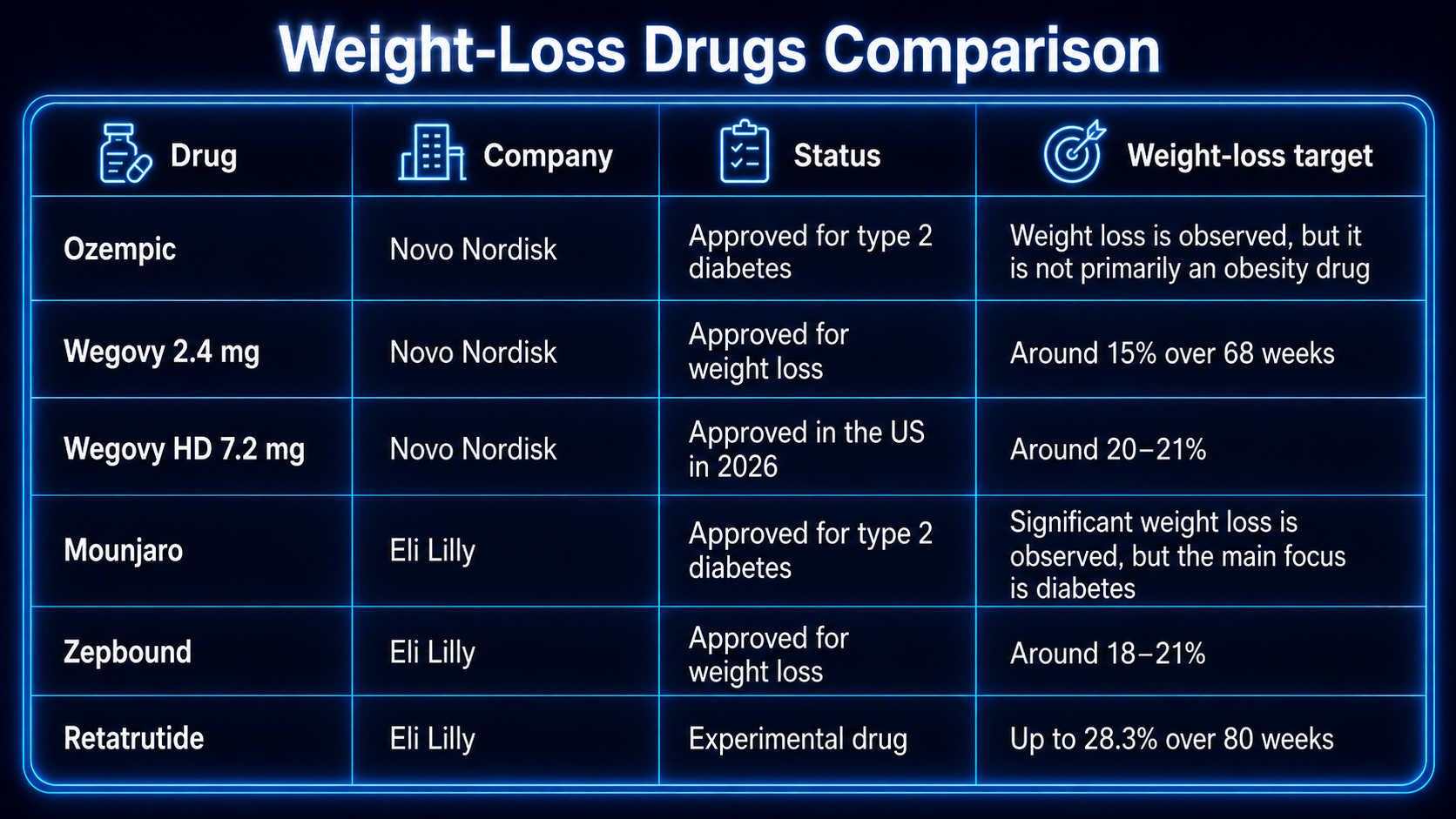
Zepbound from Eli Lilly is currently one of the most effective approved weight loss drugs. In key trials, it demonstrated weight reduction of 18–21% depending on study design and patient group.
Wegovy from Novo Nordisk previously set the market standard. The standard 2.4 mg injectable version showed 15% weight loss over 68 weeks. In 2026, Novo Nordisk extended the lineup with Wegovy HD at 7.2 mg, where weight reduction approached 20–21%.
Ozempic from Novo Nordisk is widely recognised but is primarily used for type 2 diabetes treatment. It contains semaglutide like Wegovy but is not Novo Nordisk's primary obesity drug. For the weight loss market, Wegovy remains the key competitor to Eli Lilly.
Mounjaro from Eli Lilly is formally approved for type 2 diabetes treatment, similar to Ozempic, but contains tirzepatide, the same molecule as Zepbound, and also demonstrated significant weight loss effects. The success of Mounjaro helped prepare the market for Zepbound's rapid growth and strengthened investor confidence in Eli Lilly's new drug lineup.
Against this backdrop, Retatrutide stands clearly ahead. Its result of 28.3% over 80 weeks is meaningfully higher than standard Wegovy, higher than Wegovy HD, and higher than the current Zepbound. Particularly notable is that nearly half of participants on the high dose achieved at least 30% body weight reduction.
Why Retatrutide Strengthens Eli Lilly’s Lead Over Novo Nordisk
Novo Nordisk was first to make the weight loss drug market mainstream. Wegovy became one of the world's most recognised drugs, and Ozempic turned into a cultural phenomenon despite being developed originally for diabetes. Over recent years, however, Eli Lilly has rapidly closed the gap. Zepbound began competing with Wegovy on efficacy, Mounjaro became a powerful diabetes product, and now Retatrutide adds another argument in Lilly's favour.
Novo Nordisk's challenge is that it is now in catch-up mode on efficacy. The high-dose Wegovy HD improves Novo's position, but the Retatrutide data still look stronger. If the drug is approved, Eli Lilly could gain a product that sets a new standard for the entire market.
This matters particularly because the obesity drug market is evolving. In the early phase, investors watched primarily for demand, and demand was enormous — all major players benefited. The market is now starting to focus on efficacy, tolerability, convenience, pricing, and the ability to retain patients on therapy. In that environment, the company with the strongest portfolio gains a durable advantage, and that advantage is increasingly shifting toward Eli Lilly.
Open a Trading Account at RoboForex
Swap-free accounts, spreads from 0, and execution in 0.01 seconds.
Why Retatrutide Is an Investment Catalyst
For a pharmaceutical company, clinical data translate directly into share valuation. When a drug delivers strong results in late-stage trials, the market begins pricing in future sales ahead of approval. Retatrutide has the potential to expand Eli Lilly's addressable market across several dimensions:
- Patients with insufficient response to current drugs. For those who do not achieve adequate results on Wegovy or Zepbound, a drug with stronger efficacy could represent the logical next step in treatment.
- Patients with severe obesity. In this group, weight reduction of 25–30% has significant practical value, as it can improve not only body weight but also a range of associated conditions.
- Stronger negotiating position for Eli Lilly. Better data on weight reduction and obesity-related conditions make it easier for the company to justify the drug's value to insurers and healthcare systems.
- An additional long-term revenue driver. Even if Zepbound growth begins to moderate over time, the company will have a major next-generation candidate ready to sustain sales momentum.
LLY Analyst Ratings
As of June 2026, Barchart analyst ratings for LLY shares show an unusually strong consensus: 26 out of 30 analysts recommend Buy, while the remaining 4 rate the stock as Hold. There are no Sell ratings.
Buy — 26
Hold — 4
87% Buy
26 out of 30 analysts
Hold
4 (13%)
Sell
0 (0%)
Average Target Price
1246.46 USD
Maximum Target Price
1500.00 USD
Technical Analysis of LLY
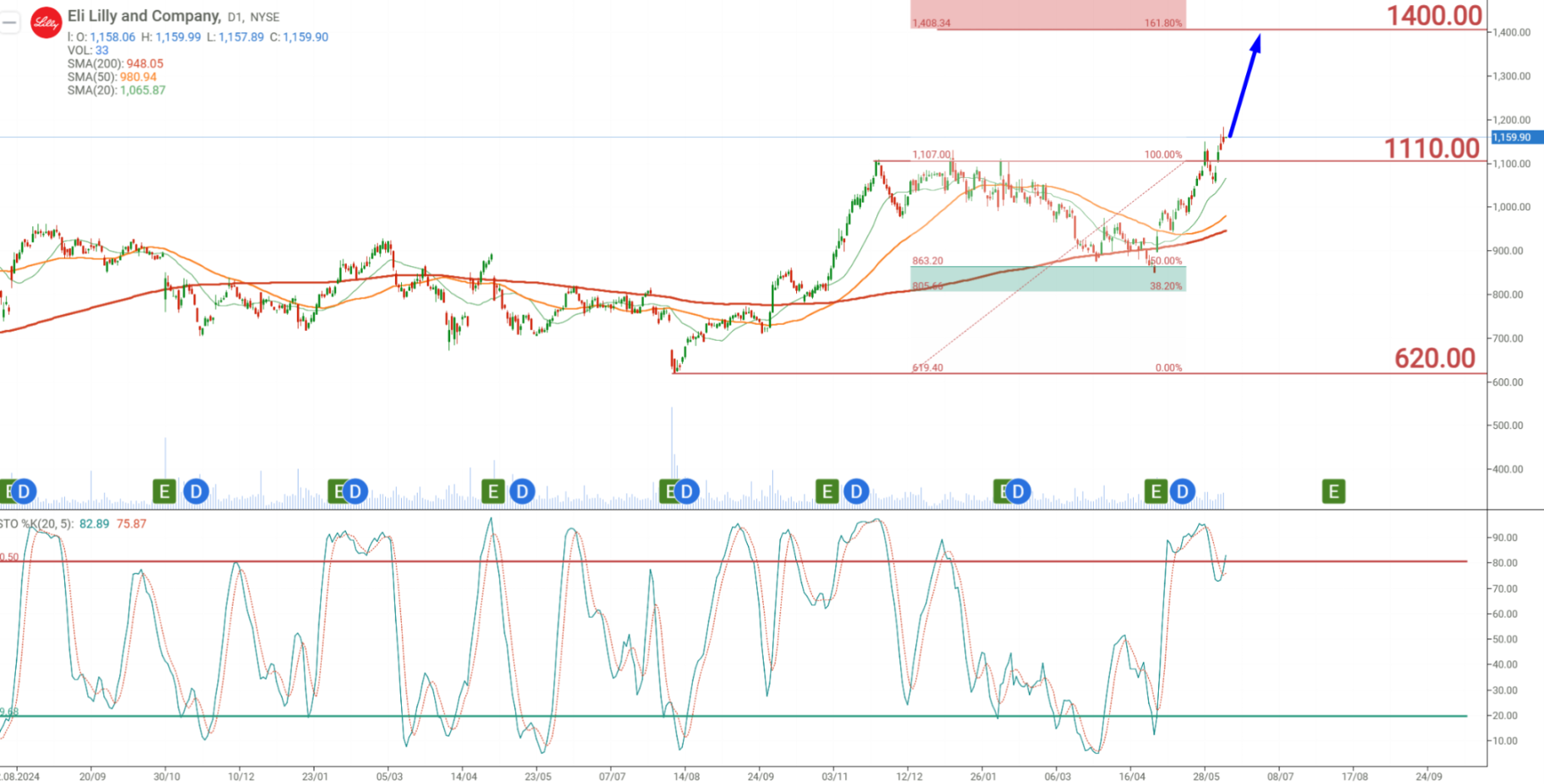
On the daily timeframe, LLY shares are trading above the 200-period Moving Average, confirming the dominance of the long-term uptrend. In addition, the price has broken through resistance at 1110 USD, which had previously acted as a historical high. That breakout reinforces the bullish scenario. The Stochastic indicator is near the overbought zone, suggesting that further upside movement may be accompanied by pullbacks along the way.
Key technical takeaways from the current chart setup:
- The 200-day Moving Average (MA200) remains well below the current price, confirming the strength of the long-term uptrend.
- The breakout above the historical high resistance level reinforces the bullish scenario and signals trend continuation.
- Stochastic is near the overbought zone, pointing to possible pullbacks as LLY moves toward the 1400 USD target.
- A market order buy represents the most balanced entry in terms of risk-to-reward.
- The Fibonacci level at 1400 USD is the nearest price target in this trade idea.
Sample Trade Strategy for LLY Shares
Below is an example trade strategy for LLY shares. This example is provided for educational purposes only and does not constitute investment advice. Investors should assess their own risk tolerance independently.
| Parameter | Value |
|---|---|
| Entry Point | Market buy at 1156 USD |
| Take Profit | 1400 USD |
| Stop Loss | 1108 USD (below support at 1110) |
| Risk / Reward Ratio | 1 : 5 |
| Position Size | No more than 3% of account |
Sample Calculation for 10 LLY Shares
| Scenario | Calculation | Result |
|---|---|---|
| Buy 10 shares at 1156 USD | 10 × 1156 USD | 11,560 USD |
| If target reached (1400 USD) | (1400 − 1156) × 10 | +2,440 USD (+21.1%) |
| If stop triggered (1108 USD) | (1156 − 1108) × 10 | −480 USD (−4.2%) |
| Risk / Reward | 480 / 2440 | 1 : 5 |
A risk-to-reward ratio of 1:5 is favourable for positional trading. Keep in mind that markets are volatile: LLY shares can move both for and against an open position.
Trade with RoboForex MobileTrader
Live charts, deposits and withdrawals, analytics and copy trading — all in one app.
Risks
Despite the strong clinical data, the investment case built around Retatrutide carries risks worth considering:
- Regulatory risk. Retatrutide is not yet an approved drug. Eli Lilly must still complete the regulatory pathway, confirm safety, agree on labelling, and prepare manufacturing at scale.
- Tolerability risk. Drugs in this class frequently cause gastrointestinal side effects including nausea, vomiting, diarrhea, and discomfort. The higher the efficacy and dose, the more carefully the market will examine the rate of side effects and patient discontinuation.
- Access and pricing risk. Even the most effective drugs can face constraints from insurers, government programmes, and patients. The obesity treatment market is vast, but affordability remains a material challenge.
- Elevated valuation of Eli Lilly shares. The stock already trades at a premium, reflecting the market's expectation of strong continued growth from Mounjaro, Zepbound, and future pipeline products. A positive clinical update does not automatically make shares cheap or safe to buy following a sharp price move.
Should You Buy Eli Lilly Shares on This News?
The Retatrutide data strengthen Eli Lilly's long-term investment case. The company is already the leader in diabetes and obesity drugs, and the new results show its portfolio can become even more powerful. Mounjaro generates enormous revenue in diabetes treatment. Zepbound is growing rapidly in the weight loss market. Eli Lilly is separately advancing oral formulations that could expand its reach to patients who prefer not to use injections. Retatrutide could become the company's next injectable drug and occupy the top tier of the weight loss market by efficacy. That positions Eli Lilly as one of the strongest pharmaceutical franchises available to investors today.
From a technical standpoint, the long-term uptrend in LLY shares remains intact, and the breakout above the historical high resistance adds further conviction to the bullish setup. Buying into a sharp move requires care, however — the company is high quality, but the valuation already reflects elevated expectations.
For a long-term investor, Eli Lilly remains a strong idea in the weight loss drug space. For a short-term buyer, the risk is that part of the Retatrutide success story is already being priced in, and further gains may come with pullbacks along the way. If the data hold through the regulatory process and the drug reaches the market, Lilly gains another major growth driver and a new efficacy benchmark for the entire obesity treatment industry.
This article is prepared for informational purposes only and does not constitute investment advice or a recommendation to execute any trading operations. Trading financial instruments involves the risk of loss of invested capital. Past results do not guarantee future performance. Before making investment decisions, please consult an independent financial adviser.
× ![]()