NVIDIA Wants to Bring AI to Every PC. What RTX Spark Means for NVDA Investors
14 minutes for reading
NVIDIA has unveiled RTX Spark at Computex 2026 — a new superchip for Windows PCs built to run powerful AI directly on the device, without relying on the cloud. For a company whose recent growth has been driven almost entirely by data centre demand, this is a significant strategic move into the next phase of personal computing.
In Brief
- NVIDIA unveiled RTX Spark, a new chip for AI-capable Windows PCs and mini-desktops.
- The chip is designed to run demanding AI tasks locally, without cloud dependency.
- Microsoft and major PC makers including ASUS, Dell, HP, and Lenovo plan to build RTX Spark devices.
- RTX Spark opens a potential new growth market for NVIDIA beyond data centres.
- 46 out of 49 analysts rate NVDA as a Buy.
- The long-term uptrend in NVDA remains intact, but Stochastic signals elevated correction risk near 195 USD.
Trade Idea Parameters
Below are the specific parameters for the NVIDIA trade idea. The ticker for trading via RoboForex MobileTrader and MT5 on RoboForex is NVDA.
| Parameter | Value |
|---|---|
| Instrument | NVIDIA Corp (NASDAQ: NVDA) |
| Ticker in MobileTrader / MT5 | NVDA |
| Idea Date | June 4, 2026 |
| Time Horizon | 1–6 months |
| Direction | ↑ Buy (Long) |
| Entry Level (trigger) | 195 USD |
| Take Profit | 270 USD |
| Stop Loss | 164 USD |
| Position Size | No more than 3% of account · Medium risk |
Instant Access to Global Markets with RoboForex MobileTrader
NVIDIA Announces RTX Spark
NVIDIA has long been seen as the primary beneficiary of the AI boom, with its graphics processors forming the backbone of the data centres where large AI models are trained and run. That segment drove a sharp jump in the company's revenue, earnings, and market capitalisation. With RTX Spark, the company is moving beyond the server market and into personal computing, aiming to put serious AI capability directly on the user's device.
The company has described RTX Spark as a "superchip" for the era of personal AI agents. The idea is straightforward: make personal computers powerful enough to handle demanding AI tasks on the device itself, without constant reliance on the cloud. For investors, this represents a meaningful expansion of NVIDIA's addressable market beyond data centres.
What Is the RTX Spark
RTX Spark is a hybrid system-on-a-chip developed by NVIDIA in collaboration with MediaTek, built on Arm architecture and designed for high-performance Windows laptops and mini-desktops. NVIDIA combined a GPU, a CPU, and a dedicated AI accelerator into a single unit built for workloads that require the machine to process complex AI requests locally.
According to NVIDIA's own specifications, RTX Spark delivers 1 petaflop of AI performance, uses a Blackwell RTX GPU alongside a 20-core Grace CPU co-developed with MediaTek, and supports up to 128 GB of unified memory. In practical terms, NVIDIA wants to put the capabilities of a compact AI supercomputer into a laptop or small desktop.
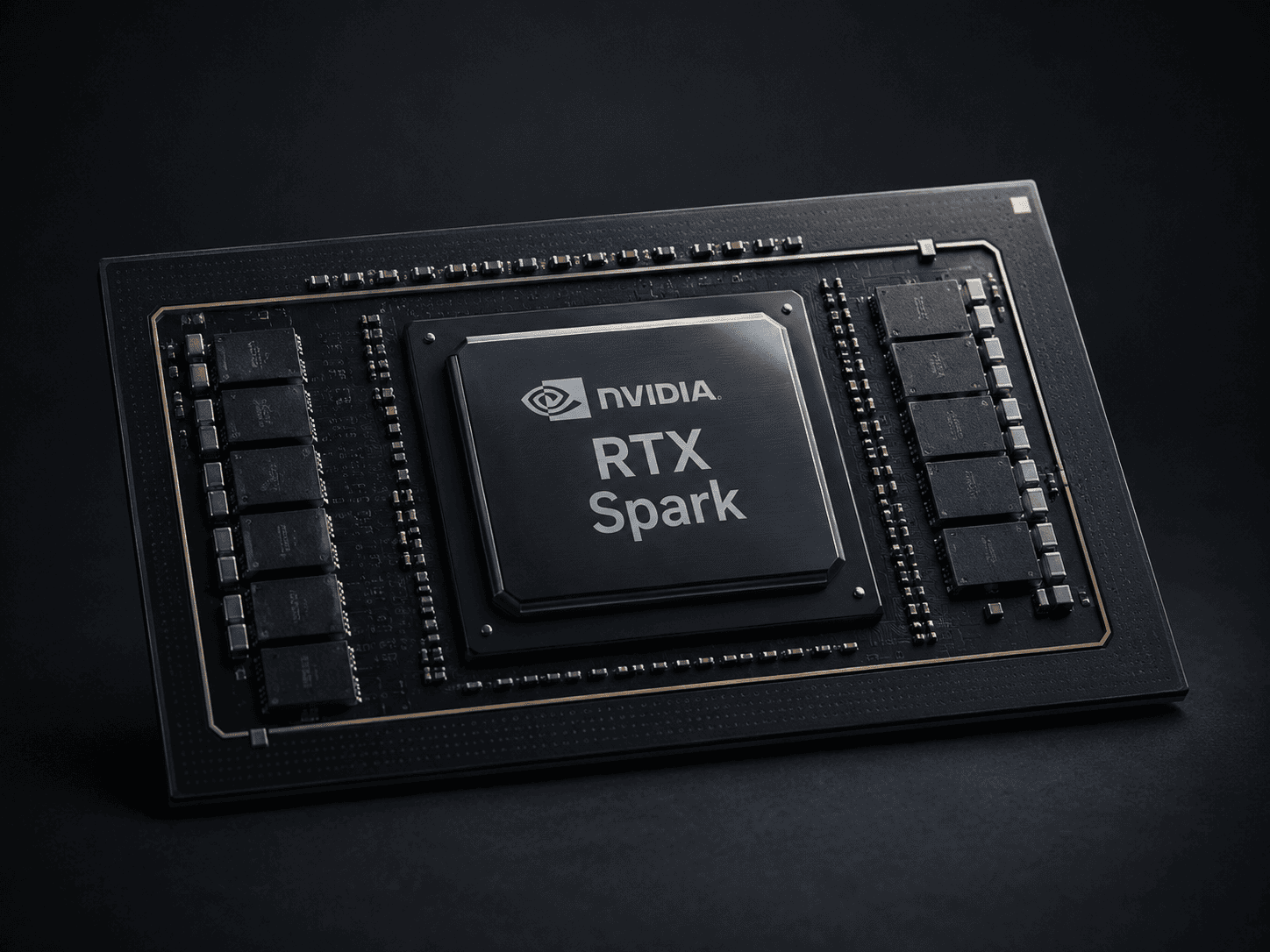
The capabilities that RTX Spark targets are significant. NVIDIA says the chip can run local large language models with up to 120 billion parameters and a context window of up to 1 million tokens, generate 4K AI video, handle complex 3D scenes, and do all of this within a thin, energy-efficient device.
Today, most of these tasks are handled through cloud servers. The user sends a request, the model processes it remotely, and the result comes back. RTX Spark is designed to handle many of these tasks directly on the device. That shift has practical advantages: lower dependence on internet connectivity, reduced latency, and fewer concerns about sending sensitive data to external servers.
Why RTX Spark Matters for NVIDIA’s Business
NVIDIA's core business today is data centres. The company's largest revenue stream comes from selling server-grade AI chips to cloud providers and technology companies building AI infrastructure. Microsoft, Amazon, Google, and Meta are all spending heavily on this capacity, and NVIDIA has been a direct beneficiary.
That model has a structural constraint. Revenue growth depends heavily on how much the largest cloud companies choose to spend on capital expenditure in any given year. Investors have already started asking how long that pace of spending can continue.
RTX Spark addresses a different market. If personal AI agents become a mainstream computing pattern — where each user has a local assistant capable of working with their files, applications, video, code, and private data — the hardware to support that will need to be substantially more powerful than a typical laptop. NVIDIA wants RTX Spark to become the chip inside that class of device.
- A broader platform for NVIDIA's AI technology. Every additional device running on NVIDIA hardware extends the company's ecosystem and strengthens its position with developers.
- Deeper ties with the developer community. Developers who can build, test, and deploy AI models locally on RTX Spark devices become more dependent on NVIDIA's tools and infrastructure.
- A share of the PC upgrade cycle. If AI drives a new wave of hardware replacement — similar to what smartphones did for the mobile market — NVIDIA is positioning itself as one of the central beneficiaries.
Microsoft and PC Makers Strengthen the Case
A powerful chip alone does not guarantee commercial success. Adoption requires operating system support, developer tools, and device manufacturers willing to build around the platform.
On the software side, RTX Spark is being positioned as a platform for Windows PCs, giving NVIDIA access to the broad installed base of Windows users and enterprises. On the hardware side, ASUS, Dell, HP, Lenovo, Microsoft Surface, and MSI are all expected to launch RTX Spark devices. That level of OEM commitment significantly reduces the risk of the product remaining a niche offering.
Historically, Intel and AMD have dominated the PC chip market, with Apple and Qualcomm making gains in recent years. RTX Spark puts NVIDIA directly into that competition, repositioning the company from a graphics supplier into a developer of chips for AI-native computing.
Open a Trading Account at RoboForex
Swap-free accounts, spreads from 0, and execution in 0.01 seconds.
Analyst Ratings for NVIDIA Stock
As of June 2026, Barchart analyst ratings for NVDA show a strong consensus in favour of buying: 46 out of 49 tracked analysts rate NVDA as a Buy, 2 as Hold, and 1 as Sell.
Buy — 46
Hold — 2
Sell — 1
46 out of 49
recommend Buy (94%)
Hold
2 (4%)
Sell
1 (2%)
Average Target Price
302.32 USD
Maximum Target
500.00 USD
NVIDIA Stock Technical Analysis
On the weekly timeframe, NVDA shares are trading above the 200-day Moving Average, confirming the long-term uptrend remains structurally intact. The 20-day and 50-day moving averages are also positioned below the current price, adding further weight to the bullish trend signal.
The Stochastic indicator is in overbought territory, pointing to an elevated probability of a corrective pullback before the next leg higher. In the current setup, the optimal entry scenario is to wait for a test of support at 195 USD, which coincides with the 20-day Moving Average. A bounce from that level would signal the end of the correction and a potential resumption of the uptrend.
NVDA is trading within a rising channel. The nearest upside target is the upper boundary of that channel near 270 USD. A break below the 165 USD support level would invalidate the bullish case — at that point the ascending trendline would be broken, with the 200-day Moving Average near 100 USD becoming the next reference point. The 270 USD level is a short-term target within the trade idea, not a ceiling for the long-term uptrend.
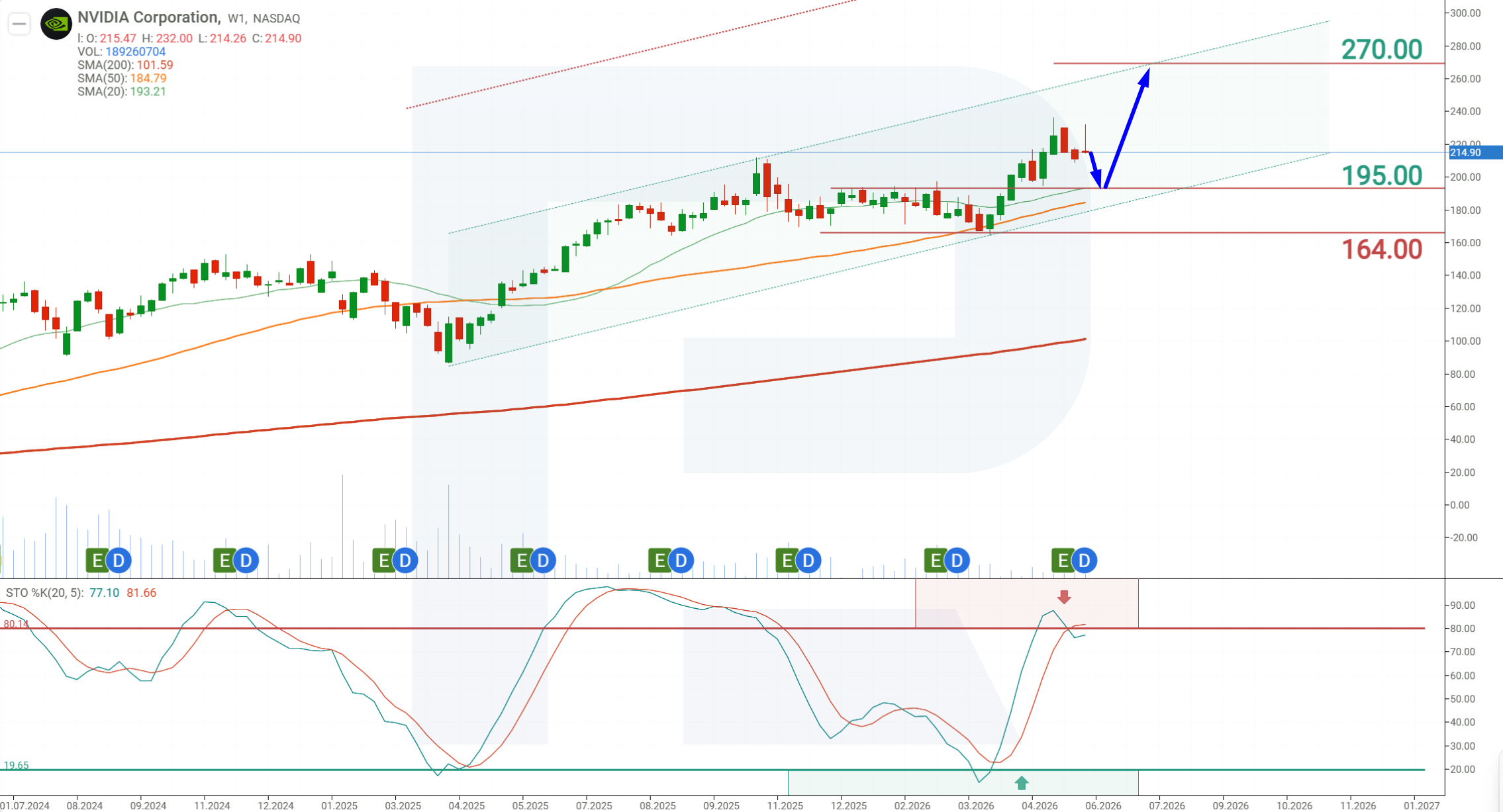
- The 200-day Moving Average (MA200) remains well below the current price, confirming the strength of the long-term uptrend.
- Stochastic is in overbought territory, raising the probability of a correction before the next upward move.
- A bounce from the 195 USD support level (aligned with the 20-day Moving Average) serves as the buy entry trigger.
- The target for this trade idea is the upper channel boundary near 270 USD.
Sample Trading Strategy for NVIDIA Stock
Below is a sample trading strategy for NVDA shares. This example is for educational purposes only and does not constitute investment advice. Investors should assess their own risk tolerance independently.
| Parameter | Value |
|---|---|
| Entry Point | Bounce from support at 195 USD per share |
| Take Profit | Upper channel boundary at 270 USD per share |
| Stop Loss | Break below 164 USD — cancels the bullish signal |
| Risk / Reward Ratio | 1 : 2.4 — potential profit is roughly 2.4× the risk |
| Position Size | No more than 3% of account |
Sample Calculation for 10 NVDA Shares
| Scenario | Calculation | Result |
|---|---|---|
| Buy 10 shares at 195 USD | 10 × 195 USD | 1,950 USD |
| If target reached (270 USD) | (270 − 195) × 10 | +750 USD (+38.4%) |
| If stop triggered (164 USD) | (195 − 164) × 10 | −310 USD (−15.9%) |
| Risk / Reward | 310 / 750 | 1 : 2.4 |
A risk/reward ratio of 1:2.4 is within the acceptable range for position trading. Keep in mind that markets are volatile: NVDA shares can move both for and against an open position.
Trade with RoboForex MobileTrader
Live charts, deposits and withdrawals, analytics and copy trading — all in one app.
Risks
RTX Spark is a strategically meaningful product, but several risk factors apply to both the product and the NVDA trade idea.
- Demand may take time to build. Most users today do not need a laptop that runs 120-billion-parameter local models or generates 4K AI video. Devices built around RTX Spark could be priced out of range for the mass market, limiting near-term commercial impact.
- Software adoption is not guaranteed. A powerful chip delivers value only when applications are written to use it effectively. NVIDIA and Microsoft will need to convince developers to optimise their software for this new category of AI PC.
- Intense competition. Intel, AMD, Apple, and Qualcomm all have AI acceleration strategies for personal computers. NVIDIA enters this market with strong GPU credentials, but the PC industry is highly price-competitive and brand loyalty matters.
- High valuation leaves little room for disappointment. Investors have long priced NVDA for strong AI-driven growth. Strong news is already partially reflected in the share price, so any signs of slowing data centre spending could weigh on the stock regardless of RTX Spark's progress.
Conclusion
The RTX Spark announcement does not change NVIDIA's investment story overnight. The company's core revenue still comes from data centre chips, and that will remain true for the foreseeable future. What the announcement does show is that NVIDIA is actively expanding its addressable market, moving into the next stage of personal computing where AI runs directly on the device.
For investors, the long-term logic is clear. If personal AI agents become a mainstream computing pattern, demand for hardware capable of handling local AI workloads will grow substantially. NVIDIA, backed by Microsoft and a broad lineup of device makers, is well positioned to capture a meaningful share of that market. The company has the technology, the developer ecosystem, and the brand recognition to make RTX Spark more than a niche product.
From a technical perspective, NVDA is holding above its 200-day Moving Average, which confirms the long-term uptrend remains active. The Stochastic indicator in overbought territory suggests a corrective move toward 195 USD support is probable before the next leg higher. A confirmed bounce from that level, with the upper channel boundary near 270 USD as the target, provides a well-defined entry for this trade idea.
* The information in this article reflects the personal opinions of the authors. It should not be construed as trading advice or a call to action. The authors and RoboForex bear no responsibility for trading results based on the recommendations and reviews contained in this material. Past performance is not a guarantee of future results. Trading stocks and CFDs involves a high risk of capital loss.