Google Signs Deal With Broadcom: A New Growth Driver for GOOGL Stock
12 minutes for reading
Google, part of the Alphabet holding, has signed a long-term agreement with Broadcom. Under the deal, Broadcom will design and supply Tensor Processing Units (TPUs) along with networking and other components for AI racks through 2031. While the financial details remain undisclosed, the nature of the partnership confirms that Google is focused on the long-term development of its own AI platform.
In Brief
- Google signed a long-term deal with Broadcom to develop TPUs and its AI platform through 2031.
- The deal seeks to reduce AI compute costs and boost Google Cloud against AWS and Microsoft.
- 50 out of 55 Wall Street analysts rate GOOGL stock as a Buy.
- Stochastic indicates the correction is over and the uptrend is resuming.
Trade Idea Parameters
Below are the specific parameters for the Google trade idea. The ticker for trading via MobileTrader and MT5 on RoboForex is GOOGL.
| Parameter | Value |
|---|---|
| Instrument | Alphabet Inc. (NASDAQ: GOOGL) |
| Ticker in MobileTrader / MT5 | GOOGL |
| Idea Date | April 16, 2026 |
| Time Horizon | 6–12 months |
| Direction | ↑ Buy (Long) |
| Entry Level | 303 USD |
| Take Profit | 380 USD |
| Stop Loss | 288 USD |
| Position Size | No more than 3% of account · Medium risk |
Instant Access to Global Markets with RoboForex MobileTrader
What Is a TPU and an AI Rack
A Tensor Processing Unit (TPU) is a specialised AI accelerator developed by Google. TPUs are used to train and run AI models and sit at the core of Gemini, Search, Photos, Maps, and the company's other AI-powered services.
An AI rack is a tall metal cabinet inside a data centre that houses compute nodes, network switches, storage elements, power distribution units, and a cooling system — essentially the building block of modern AI infrastructure.
Deal Details
The essence of the agreement between Google and Broadcom is that Google is locking in a partner it will need to build the next generation of its AI platform. Under the deal, Broadcom has committed to designing and supplying TPUs and AI-rack components for Google through 2031.
Within the contract, the roles are clearly divided. Google defines exactly which chips and server systems it needs for its data centres, Google Cloud, Gemini, and other AI services. Broadcom acts as the technology partner that turns those requirements into finished hardware and delivers it at scale. These are not Broadcom's standard mass-market products sold across the open market — they are bespoke, custom-built solutions designed specifically for Google.
Google’s Strategic Advantage
For Google, the agreement carries several layers of strategic value. It strengthens the company's grip on the AI value chain at a moment when compute capacity is becoming the single most important resource in the industry.
- Reduced dependence on third-party suppliers. The AI market today still leans heavily on general-purpose NVIDIA GPUs. By developing its own TPUs, Google gains greater control over its platform and becomes less exposed to external constraints on pricing and supply.
- Tighter integration with Google's services. In-house TPUs allow the system to be tuned more precisely for the workloads that matter most to Google — Gemini, Google Cloud, and other compute-hungry products. When the chip is designed for the task, the entire stack runs faster, more reliably, and more efficiently.
- Lower long-term cost of AI compute. If Google can run AI workloads inside its own infrastructure more cheaply, it directly improves business profitability. This matters most for Google Cloud, where AI capacity has become one of the main growth drivers.
- A stronger competitive position against AWS and Microsoft. The end goal is to attract more customers to Google Cloud for training and running AI models. With its own TPUs, Google has the option, over time, to make those services more attractively priced and more compelling for the market.
- Alphabet is strengthening its strategic advantage in the AI market. Many companies build AI models, but few are simultaneously able to design their own chips, build server systems, and operate their own data centres. Google can — which means it can control the full pipeline from silicon to cloud service.
The result is that Google is assembling a proprietary AI platform that lets it draw customers into Google Cloud, lower compute costs, reduce reliance on NVIDIA, and ultimately strengthen its competitive position in artificial intelligence. This is an attempt by Google to control the most valuable layer of an industry that will generate enormous revenue in the years ahead.
Open a Trading Account at RoboForex
Swap-free accounts, spreads from 0, and execution in 0.01 seconds.
GOOGL Analyst Ratings
As of April 2026, Barchart analyst ratings for Google stock reflect an almost unanimous consensus: 50 out of 55 tracked analysts rate GOOGL as a Buy, with the remaining 5 rating it Hold. There are no Sell ratings.
Buy — 50
Hold — 5
50 out of 55
recommend Buy (91%)
Hold
5 (9%)
Sell
0 (0%)
Average Target Price
378.72 USD
Maximum Target
420.00 USD
Google Stock Technical Analysis
On the daily timeframe, GOOGL shares are trading above the 200-day moving average, confirming that the long-term uptrend remains intact. The Broadcom news was received positively by market participants, and as a result GOOGL pushed back through both the 50-day and 20-day moving averages — strengthening the case for further upside. An additional confirmation comes from the Stochastic indicator, which has exited oversold territory, signalling the end of the corrective phase and the start of a new wave of upward movement within the broader uptrend.
Based on the current chart setup, the base-case scenario points to further gains from the 303 USD area. The nearest target is the resistance at 350 USD. A confirmed break above that level would shift the upside potential toward 380 USD. A break below the 288 USD support would invalidate the bullish scenario.
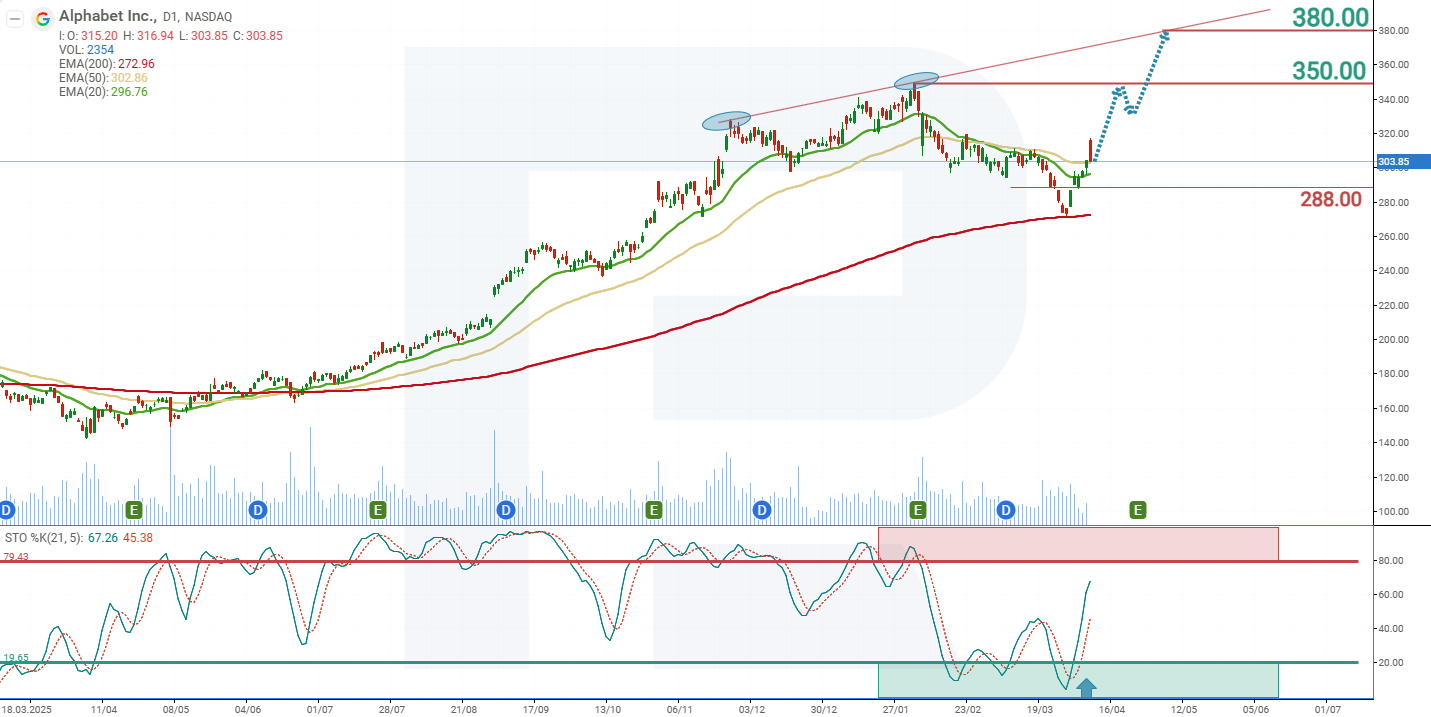
- The post-news rally in GOOGL shows a positive investor reaction and reinforces bullish sentiment.
- The 200-day moving average (MA200) sits well below the current price, confirming the strength of the long-term uptrend.
- Stochastic has exited the oversold zone, indicating that the correction is over and a new upward wave is forming within the prevailing uptrend.
- First upside target: resistance at 350 USD. Primary target: 380 USD.
Sample Trading Strategy for Google Stock
Below is a sample trading strategy for GOOGL shares. This example is for educational purposes only and does not constitute investment advice. Investors should assess their own risk tolerance independently.
| Parameter | Value |
|---|---|
| Entry Point | Buy at the current market level near 303.00 USD per share |
| Take Profit | Price reaching the resistance level at 380.00 USD per share |
| Stop Loss | Break below 288.00 USD — cancels the bullish signal |
| Risk / Reward Ratio | 1 : 5.1 — potential profit is roughly 5× the risk |
| Position Size | No more than 3% of account |
Sample Calculation for 10 GOOGL Shares
| Scenario | Calculation | Result |
|---|---|---|
| Buy 10 shares at 303 USD | 10 × 303 USD | 3,030 USD |
| If target reached (380 USD) | (380 − 303) × 10 | +770 USD (+25.4%) |
| If stop triggered (288 USD) | (303 − 288) × 10 | −150 USD (−5.0%) |
| Risk / Reward | 150 / 770 | 1 : 5.1 |
A 1:5.1 risk/reward ratio sits comfortably in the acceptable range for position trading. Keep in mind that markets are volatile: GOOGL shares can move both for and against an open position.
Trade with RoboForex MobileTrader
Live charts, deposits and withdrawals, analytics and copy trading — all in one app.
Risks
Like any trade idea, this scenario carries key risks that must be considered before making a decision.
- Massive capital expenditure. Alphabet has already indicated that capex in 2026 could rise to 175–185 billion USD, up from 91.45 billion USD a year earlier. If AI revenue grows more slowly than AI-related spending, investors may begin to view these outlays as a drag on profitability rather than as a source of future growth.
- No immediate financial impact. Neither company has disclosed the value of the contract, which makes it difficult to estimate exactly how much revenue this project will generate for Google. For now, it looks more like an investment in future capability than a near-term earnings catalyst.
- Competition. Google is reinforcing its own platform, but the AI market is already crowded with players such as NVIDIA, Microsoft, Amazon, and Meta. Google still has to prove that it can monetise its project more effectively than rivals and convert its potential edge into sustainable revenue growth.
Conclusion
Google is moving through the AI race in a deliberate and well-planned way. The Broadcom agreement is a step toward tighter control over a key component of AI compute and reduced dependence on external suppliers.
For GOOGL stock, this strengthens investor confidence that the company can genuinely scale through AI. As analysts factor in cheaper compute and rising demand for AI capacity inside Google Cloud, they may revise their earnings forecasts upward — which should support further gains in the share price.
From a technical standpoint, the stock continues to hold its uptrend above the key moving averages. The Stochastic indicator's exit from the oversold zone signals that the correction is complete and that a fresh upward wave is taking shape, with current levels still acceptable for accumulation.
* The information in this article reflects the personal opinions of the authors. It should not be construed as trading advice or a call to action. The authors and RoboForex bear no responsibility for trading results based on the recommendations and reviews contained in this material. Past performance is not a guarantee of future results. Trading stocks and CFDs involves a high risk of capital loss.